


An Operations Agent Is Not Just a Chat Box, Nor a Ground-up Rewrite — A Whitepaper for All O&M Practitioners Is Released
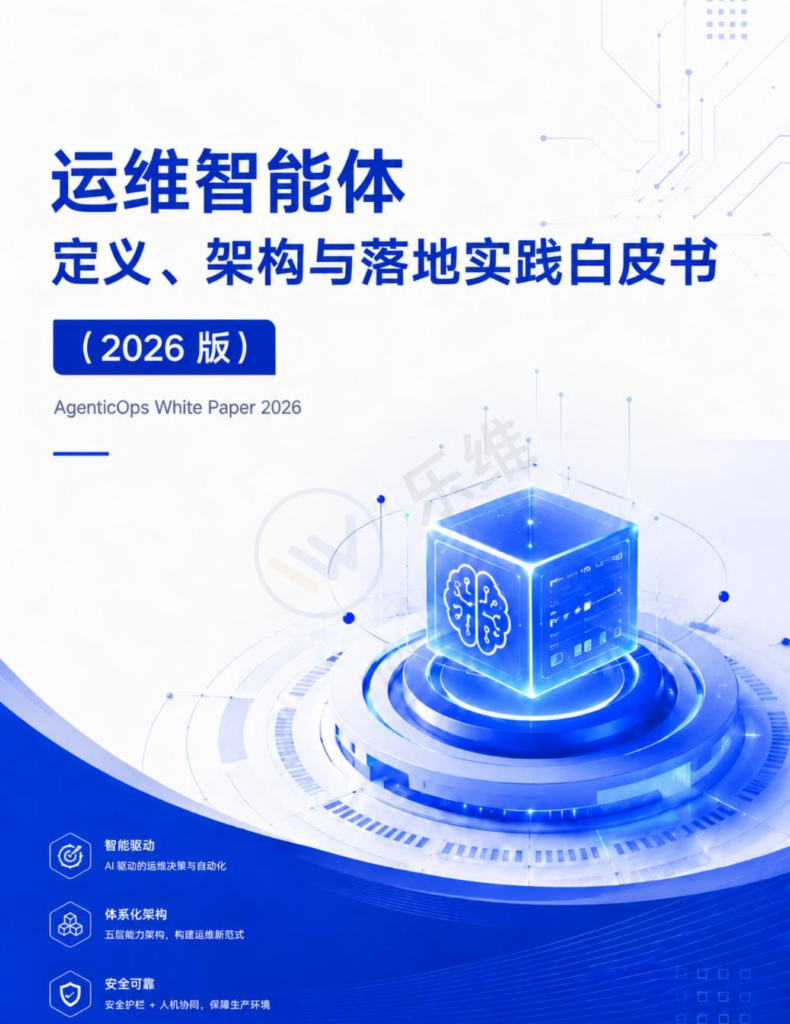
At 229 pages, with nine chapters, a five-layer architecture, a five-step implementation roadmap, and an L0–L5 maturity model for benchmarking, the Whitepaper on O&M Agent: Definition, Architecture and Implementation Practices (2026 Edition) is officially launched.
It took nearly one year of refinement, including full rewrites across nine major versions and two rounds of chapter-by-chapter community reviews. Its development draws on interviews with more than 500 customers, in-depth conversations with over 100 frontline practitioners, contributions from several veterans with 20+ years of experience, plus our own lessons learned from 16 years building O&M tools and three years developing agents.
Over the past two years, some have built O&M agents by simply adding an AI chat window to existing tools: isolated gimmicks without closed-loop workflows. Others advocate scrapping everything and building an entirely new platform — which breaks away from enterprises’ years of investment in monitoring, CMDB, automation and ITSM. Fragmentation, missing closed loops, insufficient context, plus concerns over reliability and compliance, have become four major hurdles for the industry.
This whitepaper aims to resolve these divides.
Core thesis: The value of agents lies not in replacing legacy systems, but in unlocking their potential.
The whitepaper puts forward a straightforward, distinct core view: Practically deployable O&M agents are not brand-new platforms built from scratch. They are systematic engineering built upon traditional IT O&M capabilities.
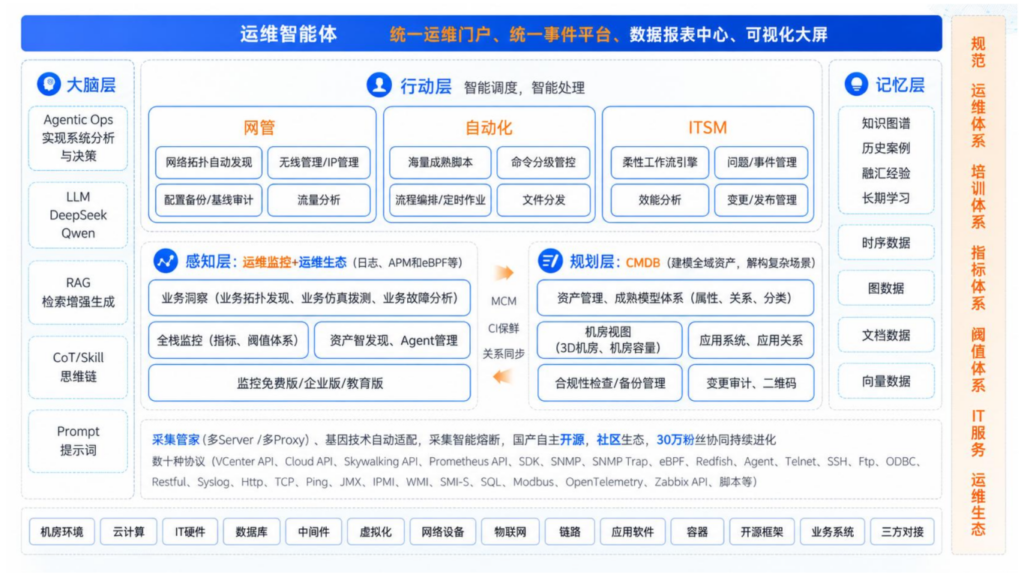
They must deeply integrate with existing monitoring, CMDB, knowledge bases, automation and metric systems. They turn an enterprise’s long-established O&M foundation into the agent’s perception and cognition capabilities, while large language models deliver reasoning and execution capacity.
The document rests on two pillars: Five-Layer Architecture × Five-Step Roadmap
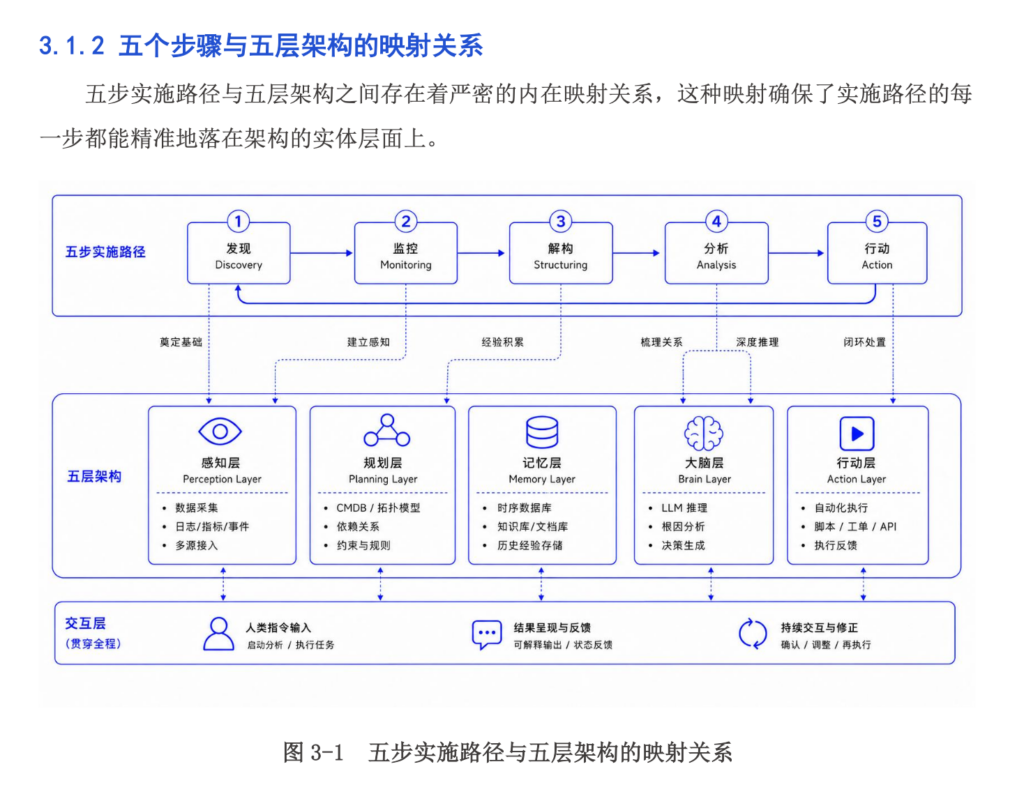
The five-layer architecture answers the question: What exactly is an O&M agent?
- Perception Layer: Collect multi-modal O&M data, filter noise and structure data to form context understandable by the agent.
- Planning Layer: Build global asset models and dependency topologies based on CMDB and graph databases.
- Memory Layer: Archive historical incident cases, knowledge base materials and decision records.
- Brain Layer: Powered by LLMs, combined with RAG and CoT for intent recognition, root cause analysis and task decomposition.
- Action Layer: Convert decisions into safe, controllable automated operations, and connect with ITSM to close the workflow loop.
The five-step implementation roadmap answers where enterprises should start: Discover → Monitor → Decompose → Analyze → Act. It provides a phased development roadmap.
In addition, the whitepaper systematically introduces the Harness engineering paradigm (Context Engineering, Architectural Constraints, Feedback Loops, Entropy Management, Safety Circuit Breakers). It addresses enterprises’ top concern: how to build agents that are usable, controllable and auditable.
A Self-Assessable Maturity Model and Quantifiable Acceptance Metrics
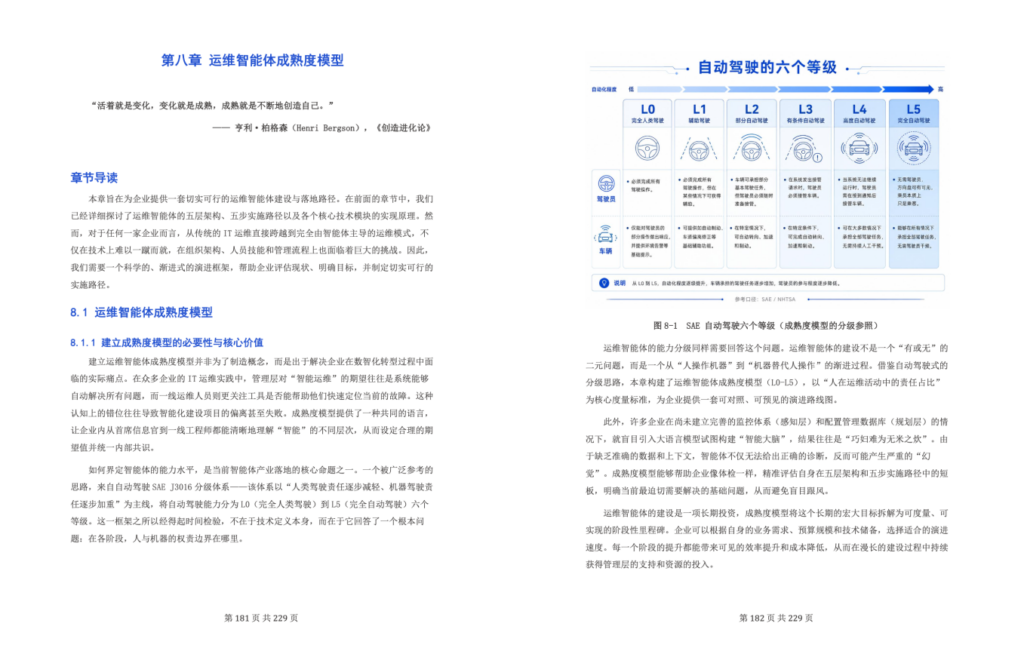
📐 IOAMM (Intelligent O&M Agent Maturity Model, L0–L5) Benchmarked against the SAE autonomous driving grading framework, it centers on the share of human accountability in O&M activities. It ranges from L0 fully manual O&M, through L3 conditional autonomy, up to L5 policy-autonomous fully autonomous digital SREs. Enterprises can use it like a health check, identifying gaps against the five-layer architecture and avoiding reckless LLM deployment before foundational monitoring and CMDB are ready.
📊 CoT Scenario Scorecard & Test Matrix It turns subjective impressions of agent performance into quantifiable, acceptance-ready engineering metrics. Under standardized test scenarios, MTTR drops from hours to minutes, and certain remediation actions reach second-level response — these value benchmarks are detailed in Chapter 7 of the whitepaper.
Who Should Read This Whitepaper
- CIOs / IT Directors: Forward-looking discussions and the maturity model in Chapter 9 help you clearly justify investment targets and phases during budget reviews.
- O&M Managers: The five-step roadmap and platform blueprint support self-assessment and evolution planning.
- Frontline Architects: Starting from Chapter 5, it covers deep technical content including Skill mechanisms, multi-database collaboration, O&M-specific RAG, CoT scenario engineering and security sandboxes.
At 229 pages, covering conceptual definitions, engineering rollout, value quantification and strategic discussion, this is one of the few comprehensive industry documents that explains O&M agents end to end.
Get Your Copy
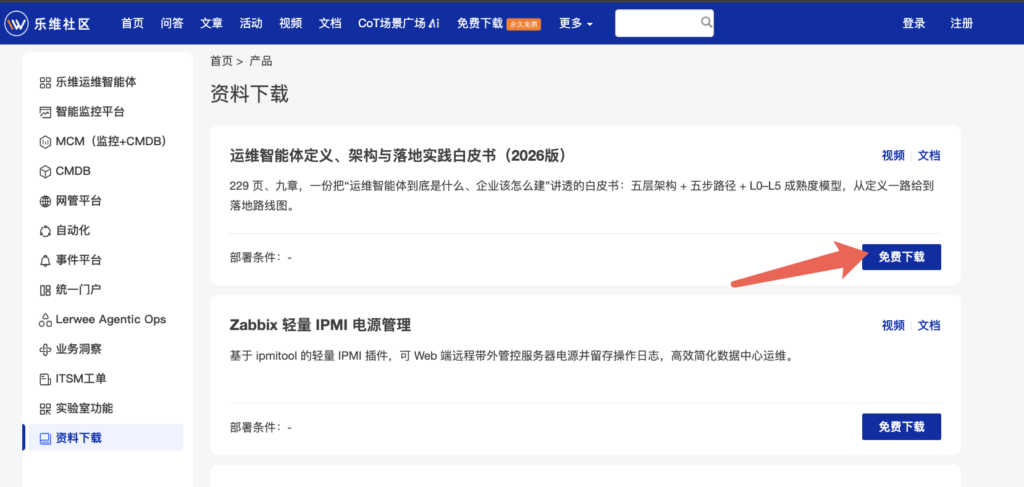
📄 Free Download: Whitepaper on O&M Agent: Definition, Architecture and Implementation Practices (2026 Edition)
- Private Sharing Session “Enabling AI to Truly Understand Enterprises” Suzhou Station Concludes Successfully
- Perseus Collection
- An Operations Agent Is Not Just a Chat Box, Nor a Ground-up Rewrite — A Whitepaper for All O&M Practitioners Is Released
- Lerwee NMS vs. Solarwinds NPM Network Performance Monitoring (Part 3)
- Essential O&M Tools! OS Monitoring Explained
- Lewei Invited to Volcengine FORCE Original Power Conference
 English
 Chinese (China)