


Lerwee Integrated O&M Solution Empowers Double First-Class Universities
Against the backdrop of in-depth advancement of education informatization, IT applications in universities have been fully deployed across teaching, office administration, campus life and other scenarios, serving as a core pillar for improving education quality and management efficiency. Meanwhile, IT infrastructure continues to expand, with a growing variety of software and hardware devices, which has greatly increased the complexity and difficulty of operation and maintenance (O&M).
With years of expertise in the O&M sector, Lerwee has gained in-depth insights into the pain points of university O&M. We have launched a dedicated integrated O&M solution for higher education institutions to address existing challenges. Deployed at a Double First-Class university, the solution has delivered comprehensive improvements to O&M capabilities, enabling centralized, visualized and data-driven O&M management and consolidating the foundational support for campus informatization.
Part 1 Project Background
1.1 Client Profile
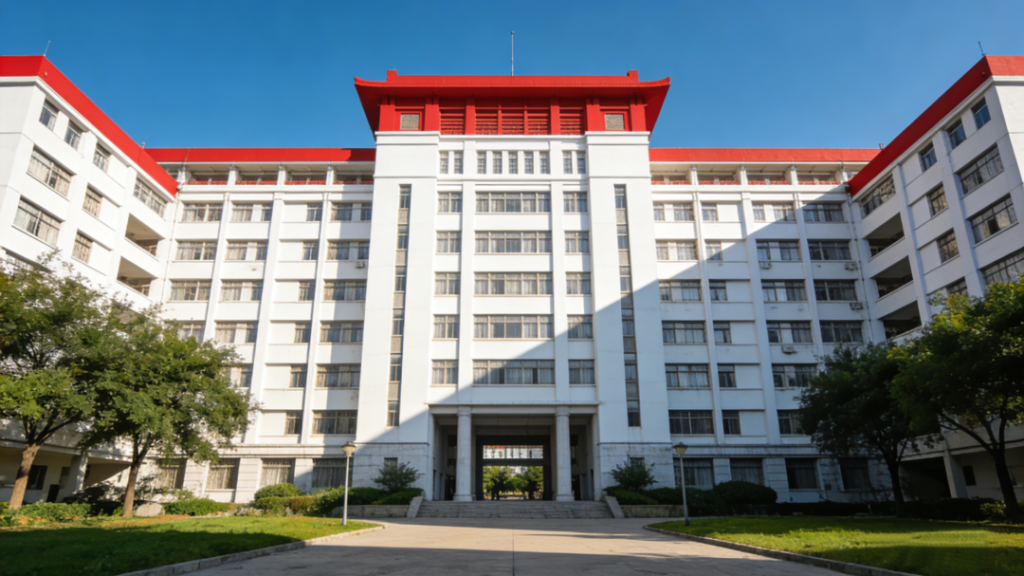
The client is a key university directly under the Ministry of Education, listed in China’s Project 211 and Double First-Class Initiative. Focused on teaching, research and innovation, the university sets stringent requirements for the standardization, stability and efficiency of informatization construction.
1.2 Key Pain Points
The university boasts large-scale IT infrastructure, comprising over 23,000 sets of software and hardware devices. The hardware includes switches, OLT, ONU, AC, AP, classroom audio and video equipment such as cameras and video recorders, storage devices and computer room environment monitoring equipment. The software covers virtualization platforms, operating systems, databases and middleware. Devices are widely distributed across multiple campuses and buildings, posing severe challenges to daily O&M.
As informatization scales up rapidly, the original O&M system can no longer meet operational needs. A host of prominent pain points have hindered the improvement of IT service quality:
- Difficult device management: A massive and diverse range of software and hardware makes overall and refined control hard to achieve.
- Inefficient fault location: Lack of effective correlation analysis tools leads to slow and inaccurate fault identification and prolonged troubleshooting.
- Fragmented O&M processes: Separate systems for alerts, assets and work orders require frequent platform switching, and problem handling lacks traceability.
- Disconnection between services and devices: O&M work focuses merely on device monitoring without clear mapping between business systems and underlying resources, making it difficult to prioritize the stability of core teaching and administrative services.
- Lack of data support for decision-making: O&M relies heavily on staff experience due to the absence of centralized statistics and in-depth data analysis, resulting in unreasonable resource allocation.
- Insufficient service assurance: IT failures undermine user experience and disrupt regular teaching activities, while the legacy O&M system fails to deliver high-quality and highly stable IT services across the campus.
Part 2 Lerwee Solution
Tailored to the university’s O&M challenges and practical demands, Lerwee delivers a customized integrated O&M solution for higher education. Centered on integrating personnel, processes and devices, the solution prioritizes rapid fault identification and resolution to boost O&M efficiency and refined management. It is designed for iterative upgrades toward AI-enabled analysis and automated troubleshooting.
Adopting mature standardized products instead of complicated customized development, the solution quickly adapts to campus requirements and builds four unified core capabilities to optimize the entire O&M workflow, each targeting specific pain points and delivering tangible value.
2.1 Unified Work Portal for One-Stop O&M Management
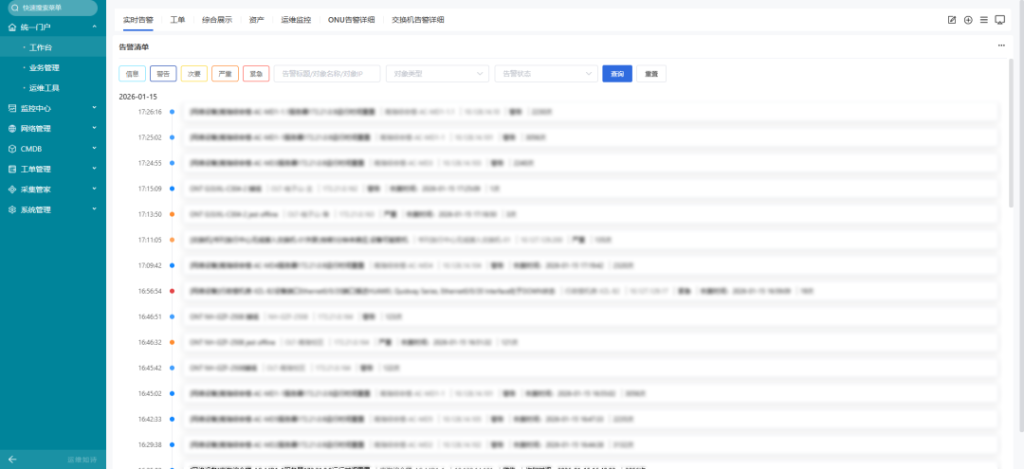
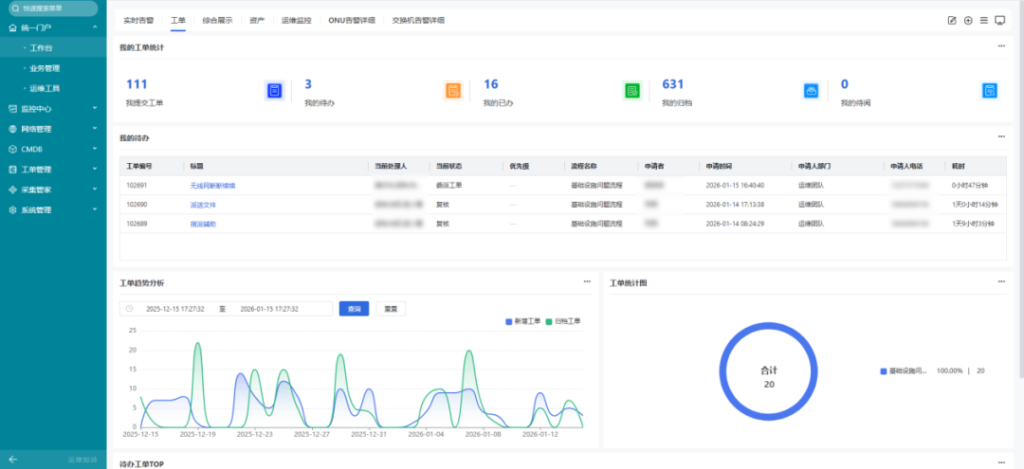
A centralized O&M portal integrates and displays scattered alerts, asset data and work order processes, realizing one-stop O&M operations. Staff can view and confirm alerts, query asset information, accept and process work orders on a single interface, eliminating efficiency losses caused by frequent system switching.
The system automatically associates alerts with corresponding devices to locate faults quickly. Combined with standardized work order workflows, it realizes closed-loop problem handling, resolving issues such as disconnected alerts, assets and work orders as well as untraceable operations. The unified portal also provides managers with a full picture of alert status, device operation and work order progress, laying a solid foundation for data-backed O&M decisions.
2.2 Unified Service Assurance System Linking Devices to Businesses
A dedicated service dashboard intuitively displays the health status of all business systems, including service availability, alert impact and operational risks, helping staff quickly spot anomalies affecting core teaching and administration. It also aggregates computing, storage, network and other underlying resources consumed by services, establishing clear mapping between business systems and infrastructure.
This shift from device-centric to business-centric O&M ensures the stable operation of core services, minimizes disruptions to teachers and students, and greatly enhances overall IT service assurance.
2.3 Unified Visualization for Full-Campus Situation Awareness
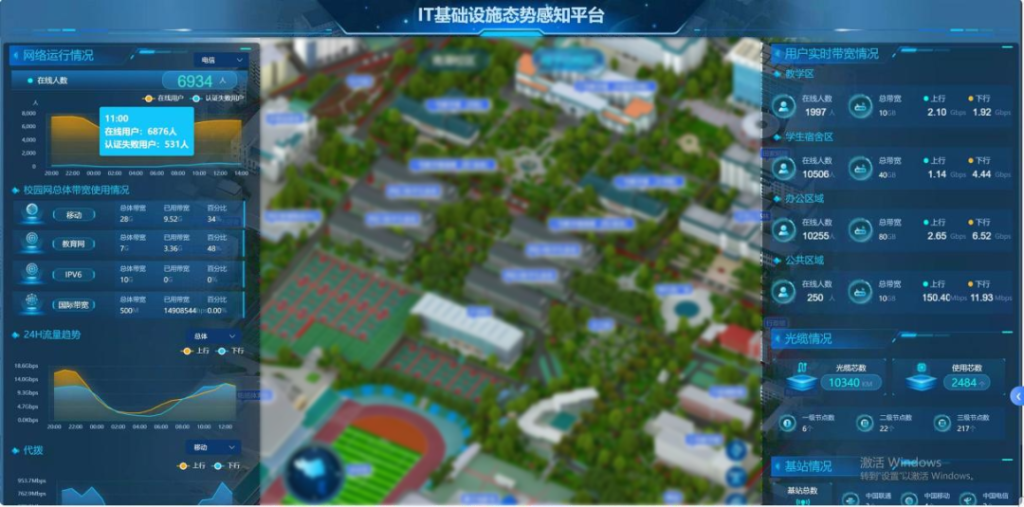
The unified visualization module presents the overall operational status of campus informatization, forming a comprehensive view covering campus networks, user access and regional distribution. Complex network data and device status are converted into intuitive graphical displays to strengthen situational awareness.
Supports multi-dimensional viewing by campus, building and area, enabling drill-down analysis from overall campus overview to regional details. Managers can monitor the status of all IT infrastructure on one screen, while O&M staff can quickly locate problematic areas. This effectively addresses difficulties arising from widely distributed devices, accelerates fault location and improves emergency response capabilities.
2.4 Unified Reporting for Data-Driven Decision-Making
The solution features centralized reporting functions to conduct statistical analysis on key O&M data and generate standardized reusable reports. It automatically produces reports on network traffic, low-load hosts and other key indicators, providing solid data support for O&M management and resource optimization.
Long-term collection and analysis of traffic data across links, devices and services reveal network usage trends to guide bandwidth planning and network optimization. Statistics on resource utilization help identify idle and underutilized devices for resource consolidation and cost reduction. Reports support multi-dimensional comparison and export for diverse scenarios, driving the transformation from experience-based to data-driven O&M and optimizing resource allocation.
Part 3 Client Benefits
Lerwee’s integrated O&M solution thoroughly addresses the university’s O&M pain points and revamps its fragmented legacy O&M system, bringing comprehensive upgrades to campus IT management:
- Realizes the transition from decentralized to centralized O&M. It resolves disconnection between alerts, assets and work orders, speeds up fault response and improves troubleshooting quality. The one-stop model cuts down repetitive work, shortens problem-solving cycles, and standardizes and traces all O&M processes.
- Establishes in-depth correlation between services and underlying resources to align O&M with core teaching and administrative demands. It transforms O&M from passive troubleshooting to proactive assurance, reducing failures of key services and enabling early detection, rapid positioning and timely resolution of infrastructure faults.
- Builds integrated full-campus situational awareness for real-time monitoring and drill-down analysis of IT infrastructure across multiple campuses and regions. Fault location efficiency is improved by over 50%, alongside stronger network O&M and emergency response capabilities. Standardized and refined management also elevates the overall professionalism and compliance of O&M work.
- Promotes the shift toward data-driven O&M. The comprehensive data analysis system supports scientific bandwidth planning, network optimization and resource consolidation for more targeted decisions. It also identifies idle resources to optimize configuration, reduce hardware waste and cut down informatization operational costs.
- Case Study | Lerwee Monitoring Helps a Large Cigarette Factory Build an Efficient O&M Monitoring System
- Case Study: Operation and Monitoring Implementation Practice of a Large-Scale Comprehensive Science and Innovation Industrial Park
- Case Insight | O&M Monitoring Platform Construction in a Large Biopharmaceutical Enterprise
- 案例解读 | 某三甲医院运维监控体系升级实例
- 案例解读 | 乐维助力某期货企业综合运维平台建设实践
- Case: Foreign-funded Auto Firm’s O&M Platform Build in China
 English
  Chinese (China)