


Case Study|Building Smart O&M System to Safeguard Core Clinical Services of Tertiary‑A Hospitals
This hospital is a Grade‑A tertiary comprehensive hospital, one of the first national key integrated Chinese and Western medicine hospitals, and a pilot institution for the national flagship program of integrated Chinese‑Western medicine collaboration. Against the backdrop of digital transformation in healthcare, hospital IT systems have become critical support for core operations including clinical treatment, administration and patient services. The explosive growth and diversification of software and hardware devices have increased the complexity of operation and maintenance (O&M). To address multiple pain points in the legacy IT O&M system, the hospital launched a unified O&M platform project to consolidate technical support for stable business delivery.
Background: Driven by Pain Points, Transformation Becomes Imperative
The hospital’s information system fully covers clinical diagnosis and treatment, medical technical examinations, administrative office work, logistics management and other business scenarios. Its IT architecture includes diverse operating systems, mainstream domestic and overseas databases, network switching devices, hyper‑converged virtualization platforms, middleware, storage and link equipment. Core systems such as HIS and LIS impose stringent requirements on real‑time performance, stability, security and compliance of IT O&M. Nevertheless, obvious deficiencies existed in the hospital’s prior IT O&M management system, with key pain points summarized below:
- Lack of monitoring platforms: Various devices were not incorporated into a unified monitoring system, leaving some devices unmonitored. Real‑time supervision could hardly be achieved relying merely on manual inspections.
- Insufficient early‑warning capability: O&M staff could not receive alerts promptly upon device anomalies. Without intelligent analysis for pre‑identification and prediction of equipment operating patterns, failures might trigger outages of core services including HIS and LIS and directly disrupt medical services.
- Isolated tool stacks: Fragmented monitoring tools created information silos. O&M personnel had to switch frequently between different systems, resulting in low monitoring efficiency.
- Absence of professional asset management system: Sources of hospital IT asset data were ambiguous; asset information lacked standardized management. Broken dependency relationships among devices prevented quick retrieval of associated asset information.
- No automated asset discovery and collection: Asset information was updated manually, which easily caused delays and errors. Low‑efficiency asset management failed to provide accurate asset topology for fault troubleshooting and business expansion.
Solution Design: O&M Upgrade via Integration of Digital Intelligence
Considering healthcare industry characteristics: 7×24 non‑stop services, strict compliance supervision, wide variety of device models and strong business interdependency, the hospital deployed Lerwee MCM (Monitoring + CMDB) integrated O&M solution targeting fragmented monitoring, reactive fault response and coarse‑grained asset management.
Centered on two‑way linkage between full‑domain perception via monitoring and full‑lifecycle asset governance through CMDB, the solution forms a closed‑loop workflow of “Discovery‑Monitoring‑Configuration‑Management”, supplemented by large‑model‑driven AI intelligent analysis, full‑stack domestic IT ecosystem compatibility and multi‑system interworking capabilities.
Instead of overhauling the legacy O&M system, the solution builds a smart O&M system tailored for hospital business scenarios through compatibility, integration and iterative upgrade. It balances implementation efficiency, construction costs and industry compliance requirements to comprehensively resolve pain points of traditional O&M.
01 Overall Platform Architecture: Building an Integrated O&M Foundation
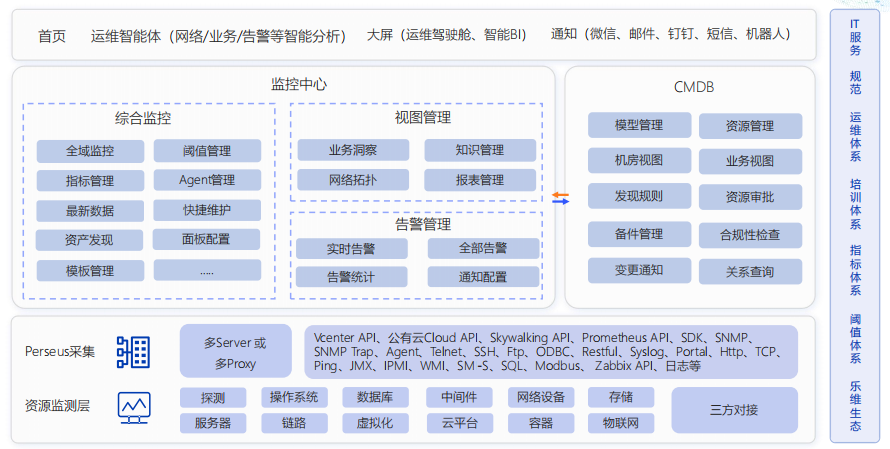
Adopting a layered, modular and extensible design, the platform consists of six layers: data collection layer, resource monitoring layer, intelligent analysis layer, visual presentation layer, asset control layer and collaborative service layer. It delivers one‑stop end‑to‑end O&M covering underlying data collection, full‑scope resource monitoring, intelligent early‑warning, visualized O&M, full‑lifecycle asset management and closed‑loop ticketing services.
Supporting smooth capacity expansion and full compatibility with domestic IT infrastructure, the platform seamlessly connects existing hospital software‑hardware systems and third‑party monitoring tools, adapting to complex healthcare IT architectures.
02 Deep Deployment in Healthcare Scenarios: Core Capabilities Rollout
Full‑Domain Unified Monitoring: Omni‑Coverage of Hospital IT Resources
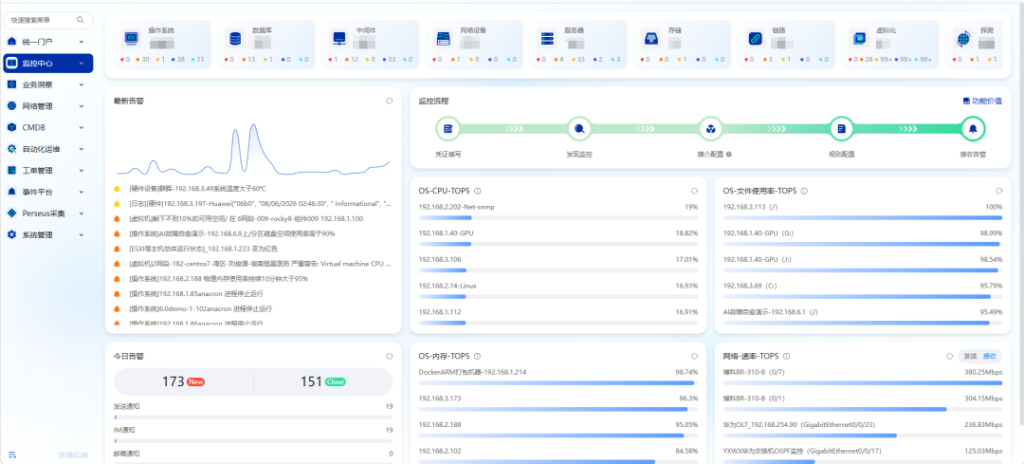
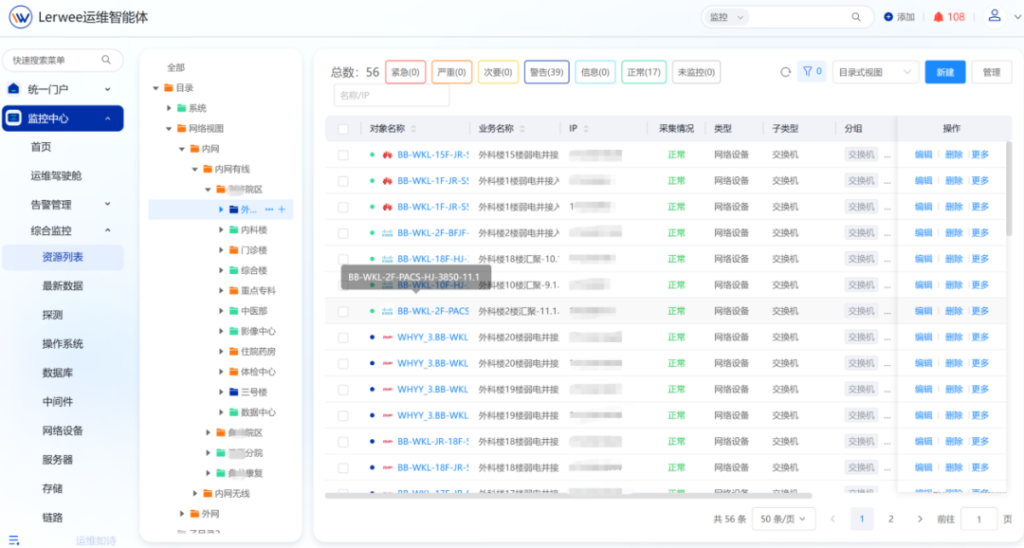
Leveraging outstanding device compatibility and scenario adaptability, the platform monitors all hospital IT software, hardware, business systems and network resources to eliminate monitoring blind spots.
- It is fully compatible with mainstream domestic and international operating systems including Windows Server, CentOS, RedHat and Kylin.
- It delivers in‑depth adaptation for mainstream databases such as MongoDB, Dameng, Kingbase, MySQL and Oracle, precisely collecting key metrics including database performance, connection counts, read‑write throughput and anomaly logs.
- It manages mainstream network devices including Huawei and Cisco equipment, accurately monitoring critical metrics such as network bandwidth, link latency and packet‑loss rate.
- In addition, it supports Web service probing, port‑process monitoring, middleware operation monitoring, resource monitoring for virtualized and hyper‑converged platforms, as well as storage device performance monitoring. Multi‑level and multi‑dimensional monitoring spans underlying hardware, basic software up to upper‑layer business applications, enabling real‑time visibility over the operational status of all hospital‑wide IT resources.
Full‑Domain Intelligent Alert Closed‑Loop System: Establishing a New Paradigm of Proactive Hospital O&M
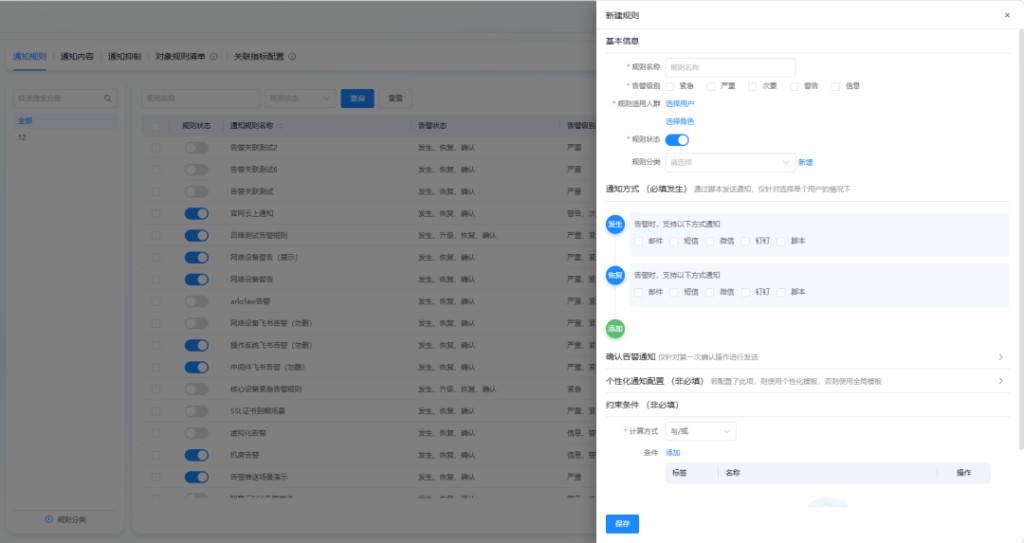
The platform implements a multi‑level, multi‑category, multi‑channel and customizable integrated intelligent alert notification system. It transforms conventional reactive O&M into full‑lifecycle management: pre‑event risk warning, rapid collaborative response during incidents, and post‑incident review and optimization.
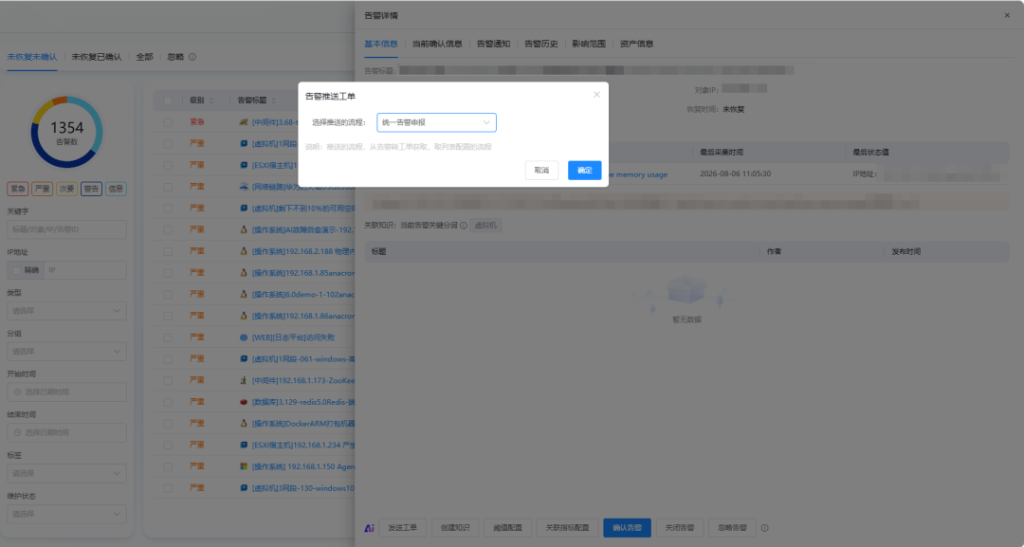
- Multi‑channel alerts and automated ticket linkage for hospital O&M scenarios: The platform integrates notification channels including emails, SMS, voice calls, WeCom and DingTalk bots. Deep integration with the hospital’s DingTalk O&M ticketing system enables automated business workflows: alerts automatically trigger ticket creation, intelligent assignment to corresponding O&M engineers, full‑progress tracking, synchronized feedback of resolution results and archived closed‑loop records. Manual intervention is minimized to achieve seamless alignment between alerts and tickets.
- Fully customizable alert strategies for precise notification delivery: O&M staff can flexibly configure alert thresholds, recipients and multi‑level escalation rules. Differentiated graded alert policies apply to device offline status, performance overload, database anomalies, link outages and other failures. Automatic escalation is activated for unread alerts, unresponded tickets and overdue unresolved incidents. Notifications are escalated to responsible personnel according to failure severity to prevent alert omission, mis‑delivery and delays.
- Mobile‑enabled cross‑team collaboration for complete O&M closed‑loops: O&M staff receive real‑time alerts and ticket pushes via DingTalk mobile terminals. On‑site machine‑room attendance is no longer mandatory; fault response and resolution can be completed anytime and anywhere, greatly shortening response time. The platform realizes a standardized O&M closed‑loop: risk detection → intelligent alert → personnel response → fault resolution → post‑mortem review → strategy optimization. It mitigates outages and system downtime risks for core medical services and guarantees stable, continuous operation of hospital information systems.
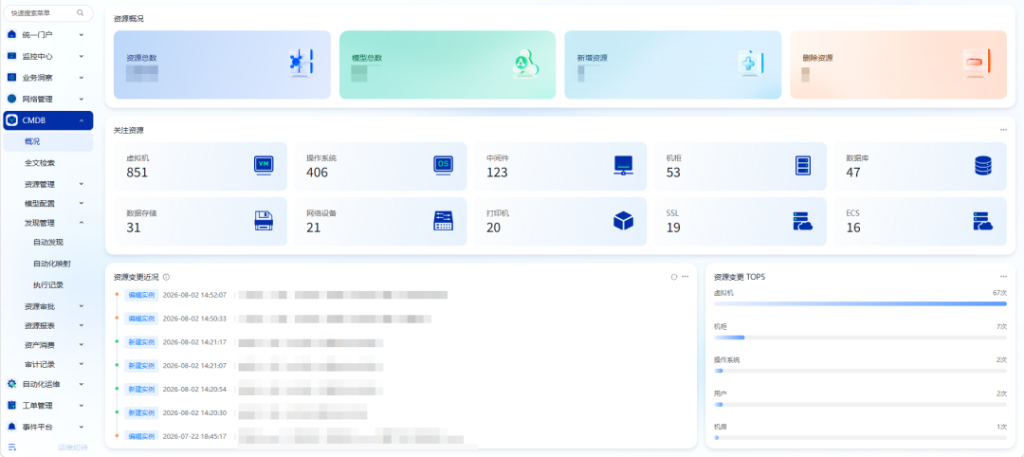
Eliminating Outdated and Chaotic Ledgers: Building the Digital Core Foundation for Hospital IT Assets
Powered by Lerwee CMDB’s full‑domain asset governance capability, the platform establishes a dedicated core data foundation for medical institutions to resolve common pain points of traditional hospital IT asset management such as disorganized ledgers and stale data.
- Automated asset discovery and multi‑dimensional intelligent collection engine: It scans all on‑premises network devices across the hospital, synchronizing full‑dimensional key information in real‑time, including asset configuration parameters, device operating status, accountable departments, service lifecycles and associated business systems. Replacing manual entry, it dynamically updates asset ledgers and ensures real‑time, accurate and complete asset data.
- Customizable CI configuration item models: Users can define dedicated configuration management specifications based on hospital organizational structures, medical business contexts and software‑hardware asset classifications. It meets healthcare asset management standards, internal control and audit compliance requirements, supporting regulatory scenarios including special hospital IT inspections and cybersecurity 等级保护 (security level protection) assessments.
- Deep integration with hospital HRP financial asset systems: It enables binding of unique asset identifiers, paperless intelligent online inventory and automatic generation of standardized ledgers. The platform covers the full asset lifecycle: procurement & warehousing, deployment, daily usage, O&M changes and disposal. End‑to‑end online standardized digital control satisfies hospital internal governance and routine compliance audit requirements for the healthcare industry.
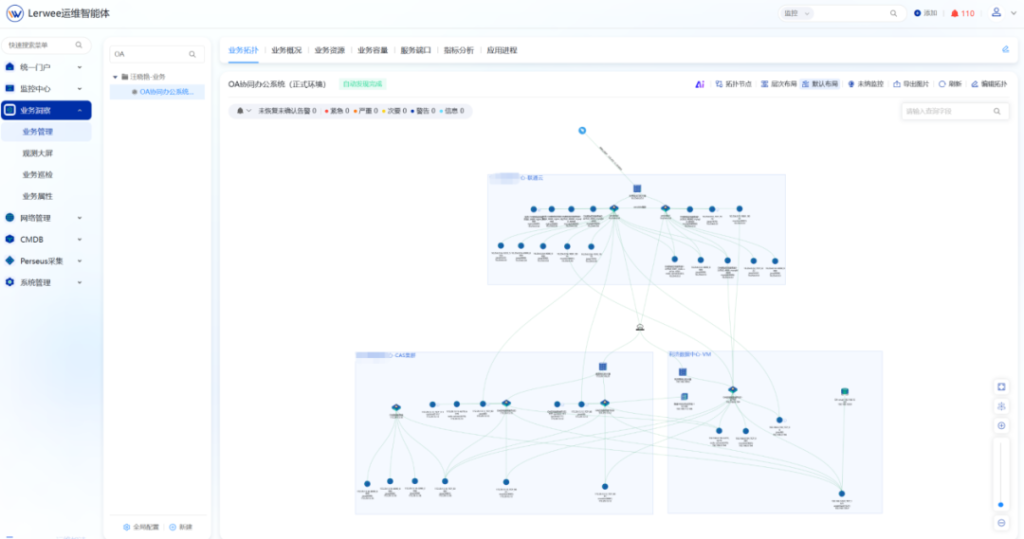
Correlating Business and Underlying Assets: Building Hospital End‑to‑End IT Insight
- It automatically identifies and generates full‑link asset topology maps, visually presenting hierarchical relationships and dependencies among medical business systems, servers, databases, middleware, network devices and links. When system failures occur, upstream and downstream related assets can be rapidly traced to drastically shorten fault localization and troubleshooting time.
- It automatically calculates quantitative indicators such as device load utilization, IT resource occupancy and equipment idle ratios, offering a holistic view of asset usage across departments. O&M and management teams can promptly identify resource idleness, imbalanced allocation and over‑utilization, providing data‑driven support for IT resource orchestration and budget planning.
AI‑Powered Intelligent O&M: Boosting Efficiency of Hospital IT Operations
Equipped with an AI intelligent analysis engine, the platform addresses traditional O&M pain points including slow troubleshooting, difficult root‑cause identification and lack of predictive capability. It improves overall efficiency in three dimensions: alert governance, risk mitigation and operational knowledge accumulation.
- Intelligent alert analysis: To mitigate disturbance caused by massive noisy alerts, it automatically parses alert sources, abnormal metrics, failure impact scope and related devices for precise root‑cause identification. Invalid and duplicate alerts are filtered to reduce O&M workload.
- Intelligent trend prediction: Prediction models built upon accumulated full‑set monitoring data forecast operational trends for servers, databases and bandwidth. Resource bottlenecks and latent faults are detected in advance to enable proactive risk warning.
- Intelligent O&M review: It periodically aggregates and intelligently analyzes complete alert and fault datasets, sorting high‑frequency issues and system deficiencies. Optimization recommendations are output to accumulate O&M experience and continuously enhance system stability.
Business Outcomes: Empowering Smart Hospital Construction and Upgrading O&M Management
- Full‑domain monitoring guarantees stable medical services: 100% coverage of hospital‑wide IT resources; 90% reduction in tool‑switching overhead; 85% improvement in fault localization efficiency; 83% drop in outage frequency for core HIS/LIS systems, consolidating the foundation for clinical operations.
- Intelligent alerts shorten incident resolution time: 95% reduction in alert detection latency; 86% cut of invalid alerts via AI filtering; 81% reduction in mean‑time‑to‑repair for major incidents. End‑to‑end online closed‑loop ticketing eliminates missed or delayed alerts.
- Digital asset management lowers manual costs: 900% improvement in asset information update timeliness; 90% reduction in inventory workload; asset data accuracy increased by 54% and relational query efficiency improved by 98%; 96% drop in preparatory work for compliance audits.
- Intelligent transformation of O&M models: Reactive “fire‑fighting” is replaced by visualized and automated O&M. Repetitive manual work is handled by the platform to reduce human errors and free up O&M manpower.
Conclusion
Tailored for hospital clinical workflows, this platform directly addresses major pain points in legacy O&M. Leveraging integrated capabilities of unified monitoring, CMDB‑based asset management, AI intelligent analysis, business insight and ticketing collaboration, it systematically solves prominent challenges including fragmented monitoring, delayed incident response, coarse asset governance and insufficient O&M efficiency.
The project realizes intelligent transformation of hospital‑wide IT O&M, establishing a solid digital foundation for stable, secure and efficient clinical services. It significantly refines the hospital’s capability for refined, standardized and intelligent IT governance.
Moving forward, the hospital will further explore platform value and expand advanced applications such as AI predictive O&M, lean asset control and business‑system‑linked O&M. Continuous iteration of the IT service system will support long‑term smart‑hospital development and lay a reliable informatization foundation for clinical care and patient experience.
- Case Study | IT Defense for Tertiary A Hospitals: Stable Medical Services Guaranteed
- Case Analysis: O&M Platform Implementation for a Global Cultural & Creative Tech Leader
- Case Study | Lerwee Monitoring Helps a Large Cigarette Factory Build an Efficient O&M Monitoring System
- Case Study: Implementation of Intelligent O&M Platform for a Macao‑based Public Water‑Supply Enterprise
- O&M Practice | Lerwee Monitoring Helps Stable Operation of Medical Business
- Lerwee Integrated O&M Solution Empowers Double First-Class Universities
 English
  Chinese (China)