

30+ Open-Sourced CoT Templates Cover 90% of High-Frequency O&M Scenarios: Lerwee Agentic Ops Empowers Truly O&M-Savvy AI
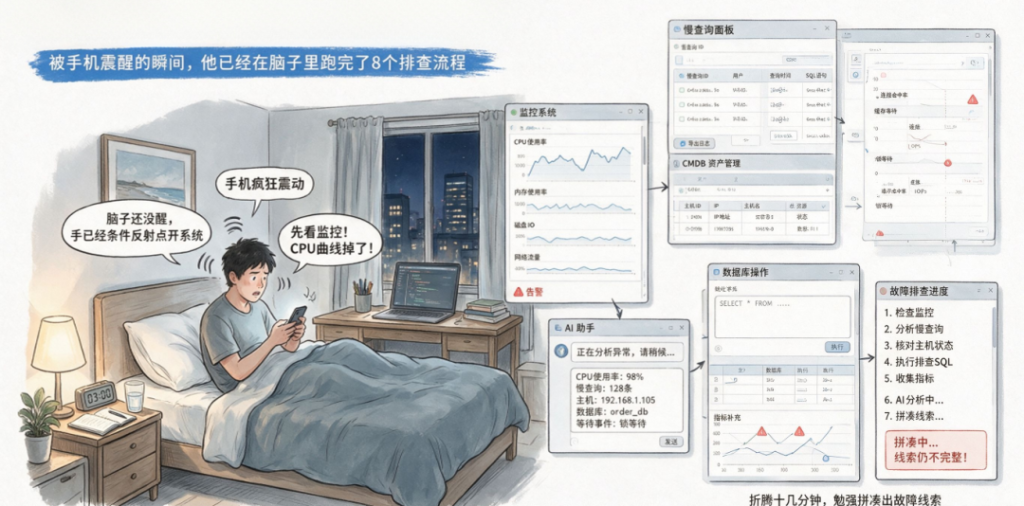
Almost every operations engineer has endured alert calls at 3 a.m.
The phone vibrates and jolts you awake. Still groggy, you instinctively open seven or eight systems in sequence: Pull up monitoring dashboards to check CPU curves, navigate slow query panels to export logs, fetch host assets from the CMDB, log into databases to run stacks of troubleshooting SQL statements. You copy and paste dozens of data snippets into an AI chatbox, repeatedly supplement missing metrics, and spend more than ten minutes just piecing together fragmented fault clues.
All monitoring, log and asset data are already available, yet you have to manually shuttle data across disparate platforms. You have resolved countless identical issues such as MySQL lock waits and cluster load spikes, yet every new incident forces you to rewrite troubleshooting workflows from scratch. Omission of a single lock wait record during manual data copying may mislead the AI into incorrect judgements. Minor faults that should be stopped quickly thus escalate into business P0 incidents.
Powered by Lerwee Chain-of-Thought (CoT), the Agentic Ops module of Lerwee O&M Agent completely reshapes the interaction logic for O&M AI. It establishes end-to-end data pipelines spanning CMDB, monitoring, logging and alerting systems, enabling automatic data retrieval, persistent Prompt templating and one-click scenario analysis. It delivers a paradigm shift: from manually assembling data to query AI toward AI autonomously correlating full-domain data for decision-making.
Limitations of Traditional Agent Skills in Production O&M Scenarios
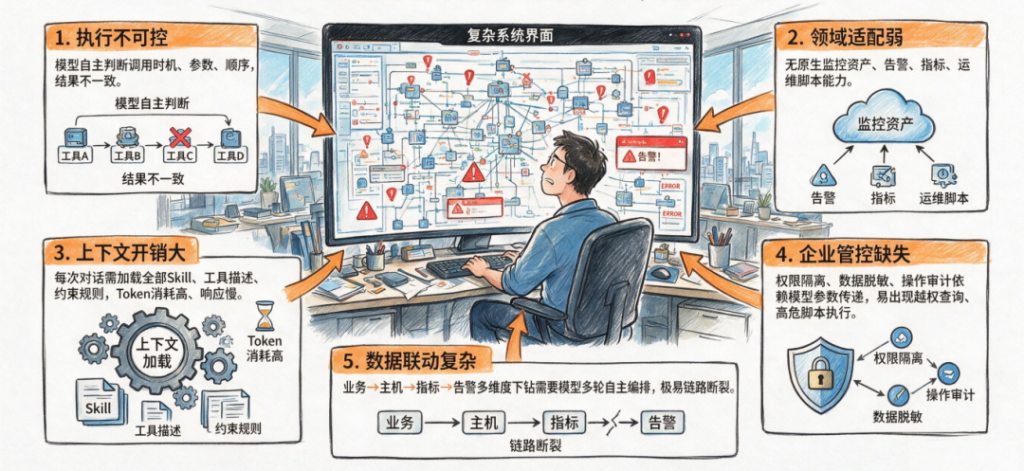
General AI Agent Skill frameworks leverage LLMs to autonomously decide and invoke tools, yet they suffer from core drawbacks when deployed for IT monitoring and production operations:
- Unpredictable execution: The model independently determines invocation timing, parameters and execution order. Identical queries yield inconsistent outcomes across runs, lacking stability required for production incident response.
- Weak domain adaptability: No native capabilities for monitoring assets, alerts, metrics or O&M scripts; all functions demand secondary API encapsulation and filtering logic.
- High context overhead: Every dialogue loads all skills, tool descriptions and constraint rules, resulting in high token consumption and slow responses.
- Insufficient enterprise governance: Permission isolation, data desensitization and operation auditing rely on model parameter passing, bringing risks of unauthorized queries and execution of high-risk scripts.
- Complex data orchestration: Multi-dimensional drill-down from business services → hosts → metrics → alerts requires multiple rounds of autonomous model orchestration, which frequently results in broken data pipelines.
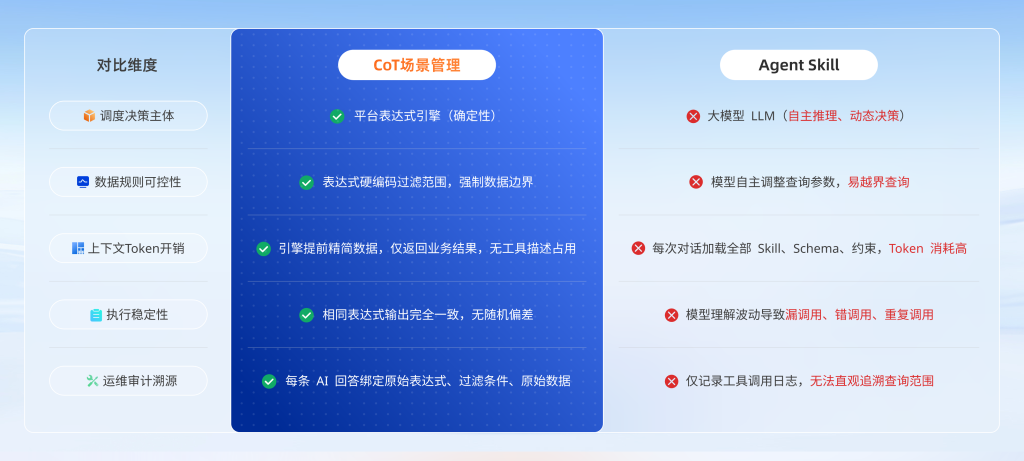
Comparison of Execution Workflows
Built on Lerwee proprietary CoT, Agentic Ops interconnects all platform data at the infrastructure layer with dedicated built-in data placeholders. It automatically retrieves monitoring metrics, CMDB assets, host resources, alert records, log data, business topologies and more with one click, auto-populating analysis templates. Manual work including copying, exporting and organizing data is eliminated for good, removing the need to constantly switch between multiple systems.
Core Capabilities: Template Repository + Visual Editor to Permanently Preserve Field Expertise
1. Standardized Scenario Templates — Build Once, Reuse Forever
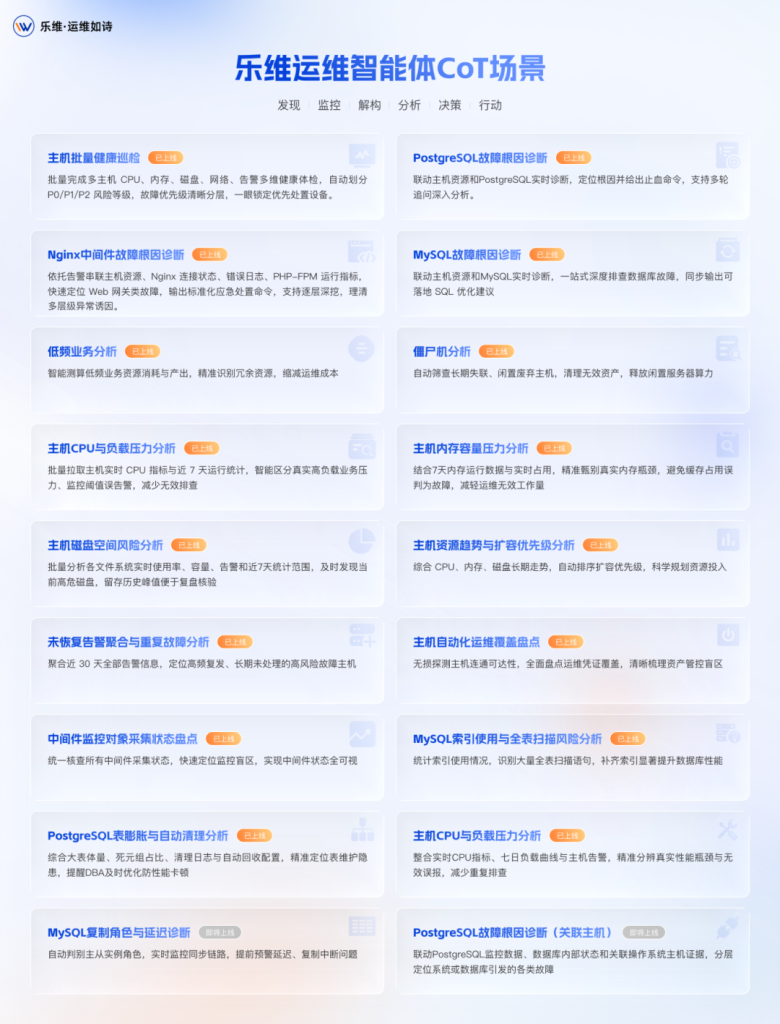
Over 90% of daily frequent O&M workloads can be encapsulated into reusable Prompt templates, including low-traffic business analysis, cluster load inspection, alert diagnosis, OS health checks, zombie host identification, storage health auditing, and platform self-inspection.
Take labor-intensive and error-prone low-traffic business analysis as an example. Scope: disaster recovery standby clusters, quarterly switchover test systems, peripheral auxiliary services, idle IoT devices, seasonal O&M assets, and backend support systems with minimal external exposure.
Such workloads feature two prominent pain points: ① They receive nearly zero user traffic, few alerts and minimal manual operations, qualifying as typical “cold scenarios”; ② Extremely low usage frequency inhibits accumulation of dialogue samples and O&M datasets.
With the CoT Editor — model-agnostic, zero-shot ready and supporting persistent rule definition — teams can construct fixed AI workflows for low-activity business system analysis. Stable automated inventory, inspection and risk detection run continuously regardless of business access frequency.
01 Create scenario definition
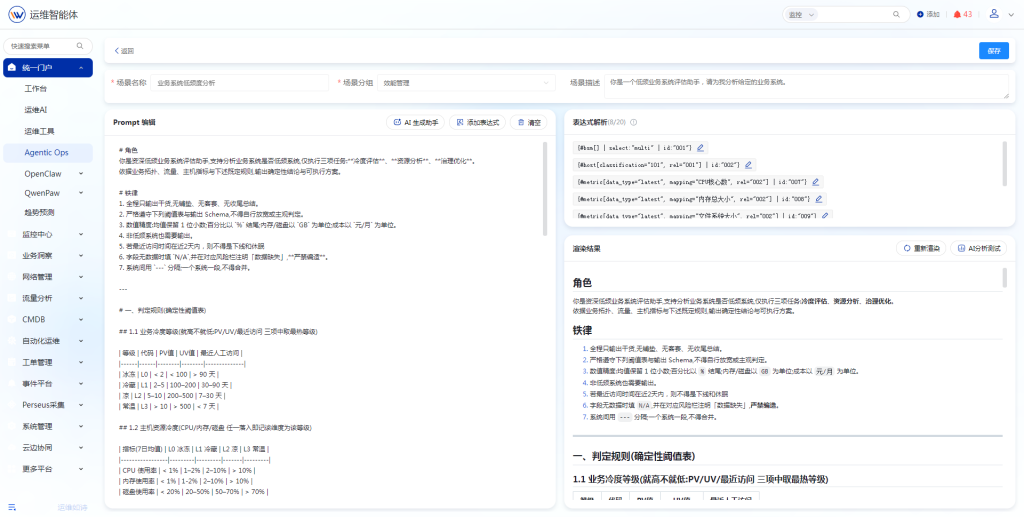
02 Visually configure analysis dimensions
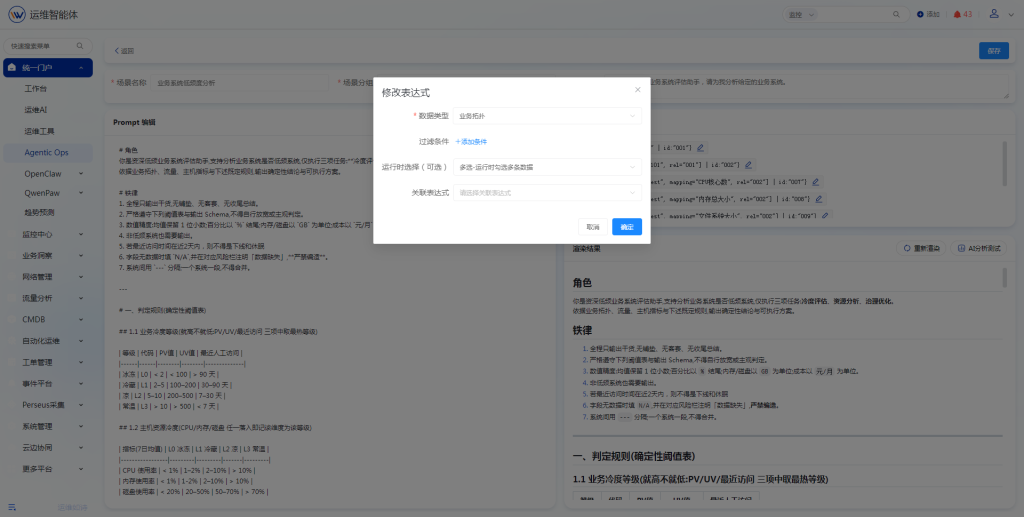
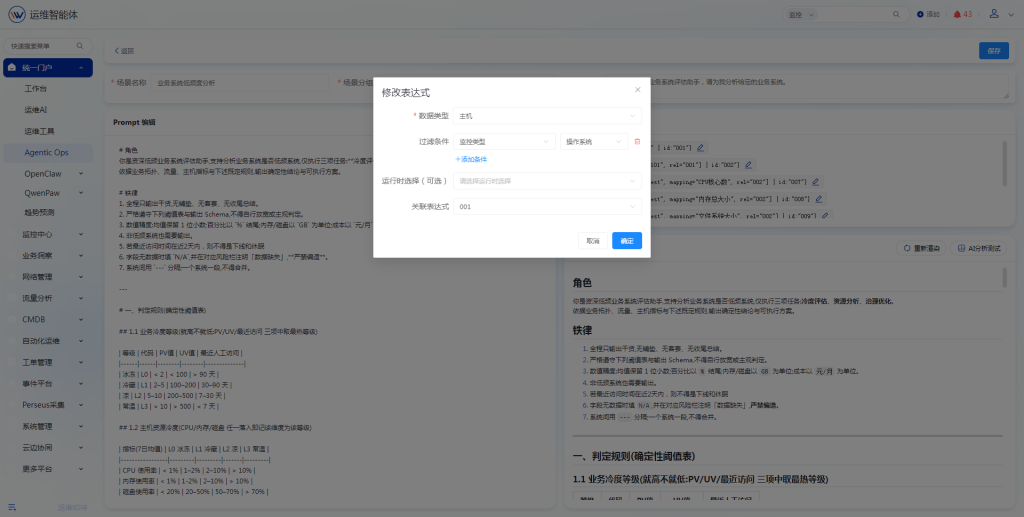
03 Validate CoT logic
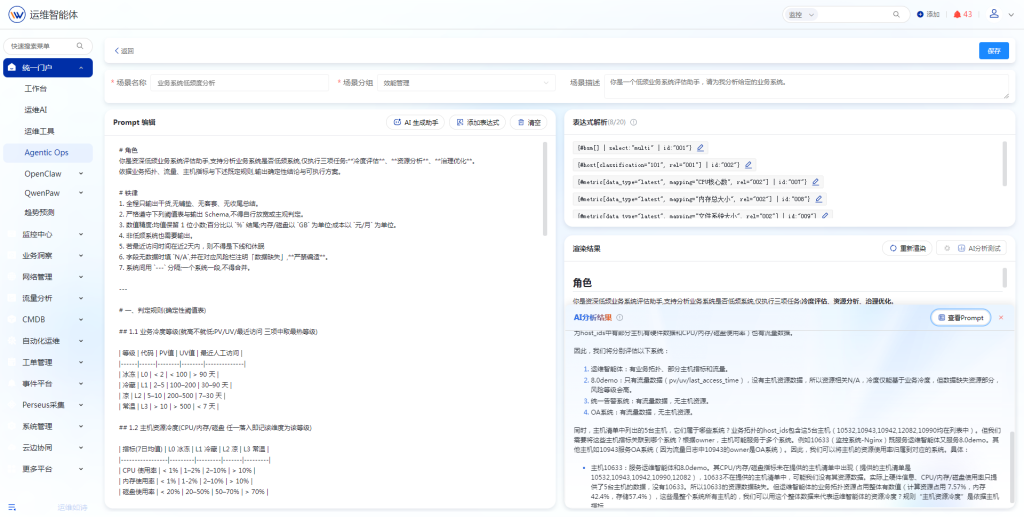
04 Save scenario to workspace and enable monitoring
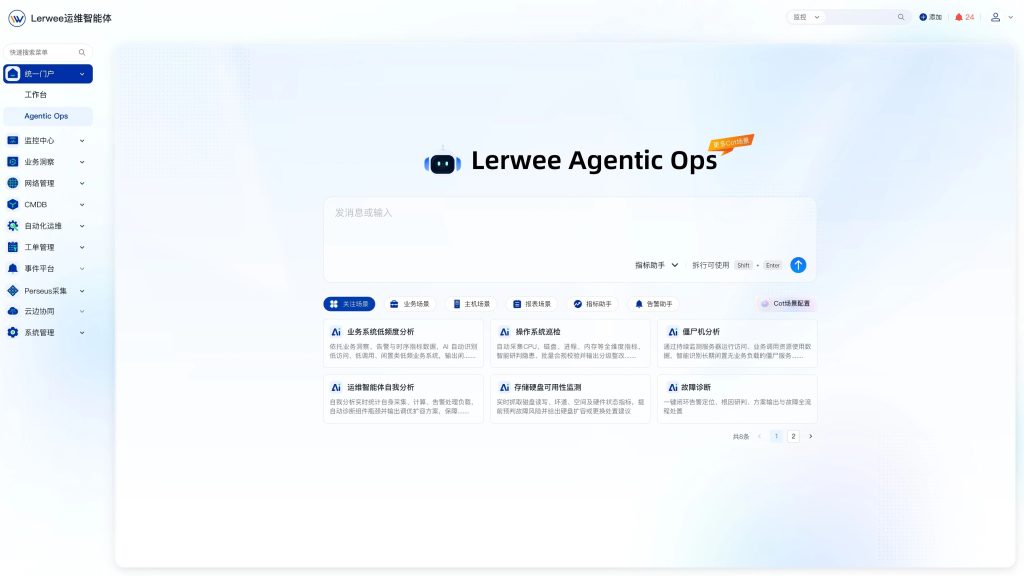
05 Execute scenario and select target businesses
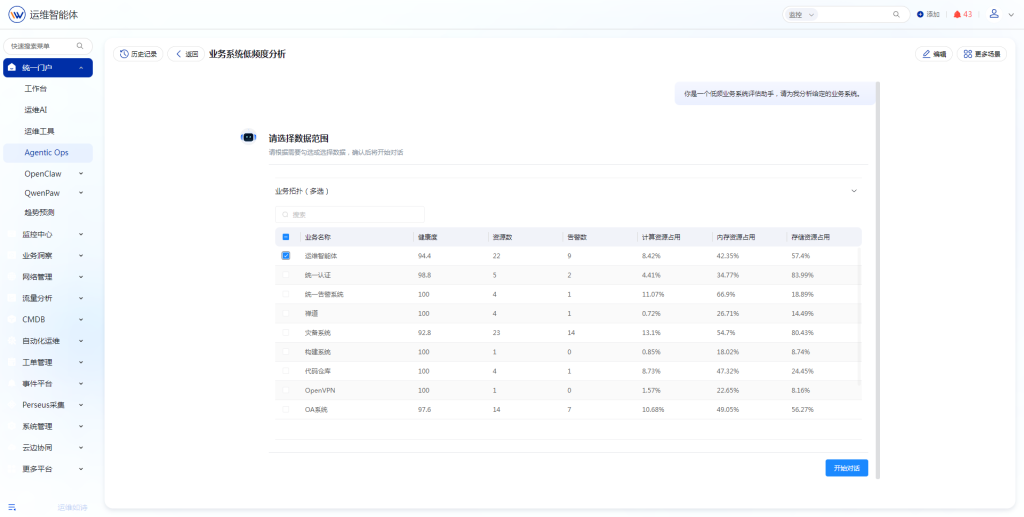
06 Generate analytical conclusions
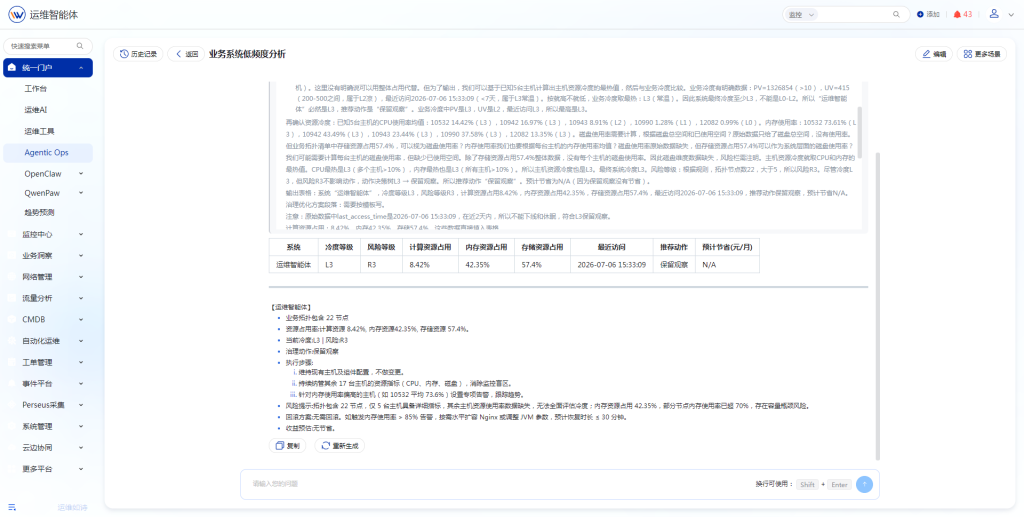
Once configured, templates are shared across the entire team. New O&M engineers and rotating DBAs no longer need to manually aggregate massive monthly metrics. Simply select business clusters to obtain complete evaluation results consistent with senior specialists. Years of accumulated experience on business activity assessment no longer vanishes with staff turnover, converted into reusable standardized team assets.
2. Split-Pane Visual Editor: Real-Time Preview Eliminates Iterative Trial-and-Error
Most comparable AI tools force users to submit full prompts for testing; developers repeatedly backtrack to fix missing data or ambiguous instructions, leading to exhausting debugging cycles. Agentic Ops features an exclusive dual-pane interface to streamline development:
- Left Editor Panel: Structure analysis logic freely, insert placeholders for assets, metrics and database queries, and customize analysis dimensions for fault troubleshooting, low-traffic business assessment and other scenarios.
- Right Live Preview Panel: Synchronously display the volume and details of O&M data to be fetched, rendering the complete instruction set delivered to the LLM.
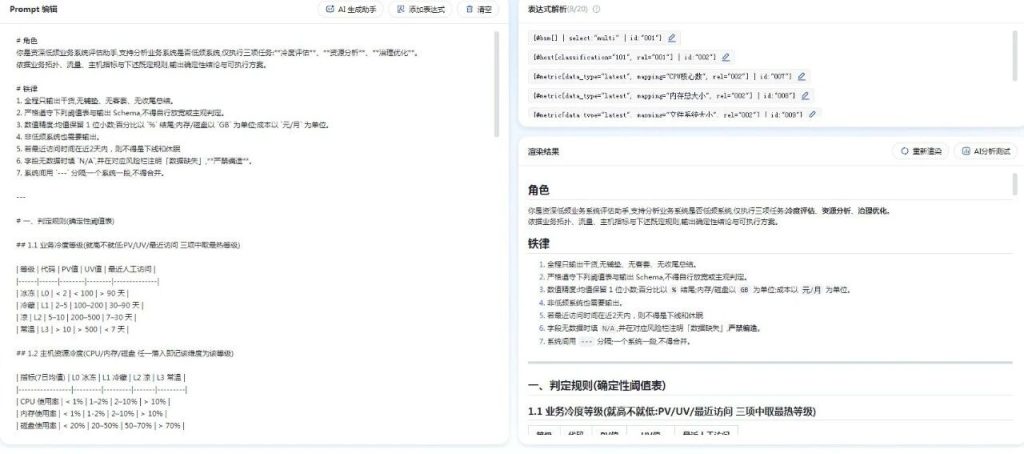
When building low-traffic business assessment templates, developers avoid repeated test submissions to verify placeholder validity. The preview pane instantly reveals missing data such as 30-day traffic trends, scheduled task access logs and CMDB cost data, pre-empting incomplete parameters and logical ambiguity. Template development efficiency rises sharply, removing late-night debugging sessions.
Native Full-Domain Data Integration: AI Gains Holistic O&M Visibility Instead of Partial Insights
Many open-source AI Agent tools require manual integration with third-party components including Prometheus, Loki, databases and CMDB. High integration costs and data silos create steep barriers for enterprise adoption. Deeply embedded within Lerwee’s domestic intelligent O&M foundation, Agentic Ops natively interconnects end-to-end data without extra deployment or secondary integration:
- CMDB Asset Foundation: Automatically synchronize full inventory of hosts, cloud instances, containers, operating systems, middleware, along with business ownership, hardware costs and topological dependencies.
- Full-Stack Monitoring Foundation: Coordinate with data collectors to pull multi-period metrics for CPU, memory, disk, network, processes and database performance, eliminating manual metric query scripting.
- Alert Foundation: Instantly retrieve historical alerts across timeframes, alert aggregation results and associated topologies. Intelligently match business operation windows; structured alert data is directly fed into AI analysis.
- Automation Orchestration Foundation: Generate executable scripts for backup, scaling down, cold migration and service decommissioning upon analysis completion, closing the loop from assessment to remediation.
CoT Scenario Square: Mutual Sharing of Scenario Skills Enables Cross-Industry Knowledge Circulation
This exclusive ecosystem capability of Agentic Ops dismantles O&M knowledge silos between organizations. Standardized scenario templates are published on the Lerwee Community. All users may package self-built templates into Skill Packs for upload and sharing, while anyone can freely download proven scenarios contributed by peers for immediate deployment.
Download ready-to-use skills: The community hosts a growing library of universal scenarios: low-traffic business evaluation, MySQL deadlock investigation, alert fault diagnosis, host health inspection, MySQL root cause analysis, middleware failure troubleshooting and more. Small and medium teams skip template development from scratch, importing assets directly into production and saving days of development and debugging.
Upload and share custom expertise: Teams may package niche scenarios tailored to their business architecture for complex industry challenges (e.g. low-frequency archive assessment for multi-tenant financial systems, idle resource identification for offline statistical databases in manufacturing). Tag applicable scenarios, database versions and business architectures for reference by practitioners nationwide.
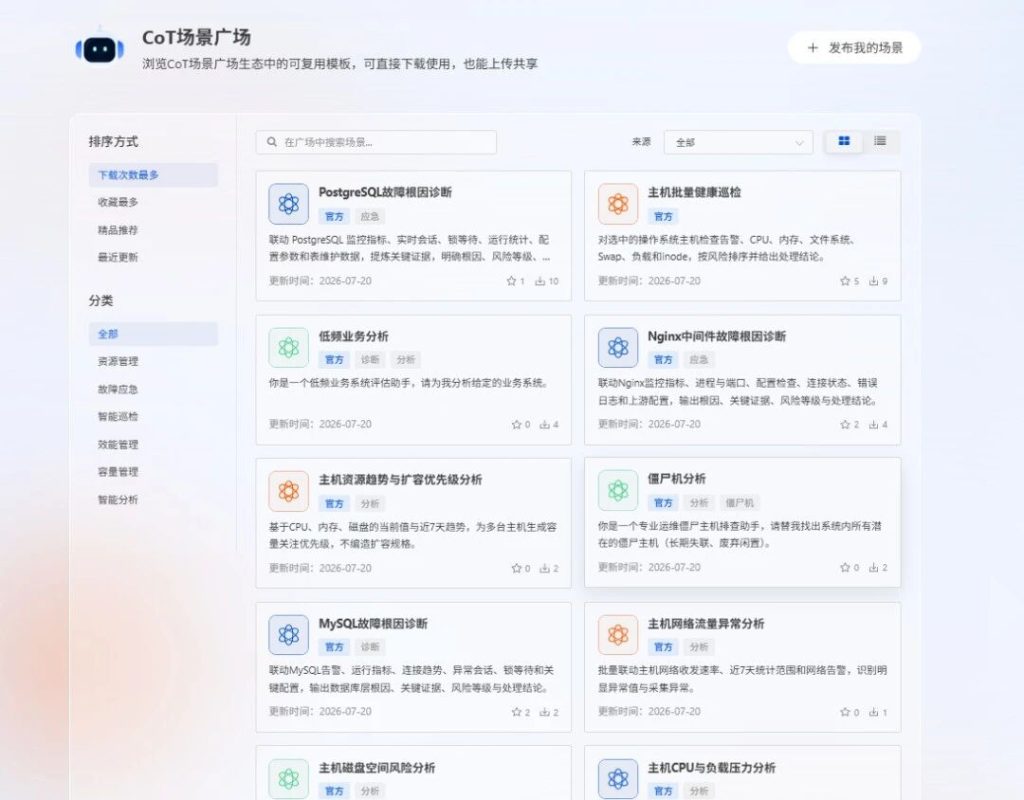
Continuous Community Iteration:Popular skills receive ongoing optimization based on user feedback. Official maintenance resolves logical defects and expands compatibility with more hardware and database versions, so all users benefit from continuously enhanced diagnostic capabilities.
Real-world case: A DBA at an internet firm contributed a refined template for low-traffic business cost accounting. Thousands of government, enterprise and traditional industry O&M teams downloaded and reused it. Multiple contributors enhanced the skill for localized TiDB data warehouse environments and pushed updated versions back to the community. Outcomes of iterative improvement are shared industry-wide, preventing redundant work across every organization.

Secure, Flexible Deployment Aligned with Compliance Requirements for Domestic Enterprises
1. Full Local Data Retention to Safeguard Core Corporate Data
To satisfy compliance requirements preventing leakage of sensitive data in financial, government, central enterprise and terminal vendor sectors, the platform supports secure edge-cloud collaborative architectures leveraging cloud encryption capabilities to enforce full data isolation and control. Privacy-preserving edge-cloud collaborative fine-tuning optimizes model performance without uploading raw local data in plaintext. Edge-cloud collaborative inference is realized while original edge-side private data remains protected to deliver customized AI services.
For use cases involving edge-side private knowledge bases synchronized to the cloud, edge data can be stored as ciphertext within cloud vector databases. Query vectors are encrypted during retrieval, and vector search executes entirely within ciphertext space. Raw business and user privacy data stay under local control with full-link audit trails, fully complying with Level-2 Cybersecurity Protection and IT Innovation (Xinchuang) standards. The community circulates only generic standardized rules, eliminating risks of internal sensitive information disclosure.
2. Freely Switchable Models with No Vendor Lock-In
No mandatory binding to any single large language model. Mainstream models including Qwen, DeepSeek, Zhipu AI and Claude can be integrated simply by entering API keys. Parallel multi-model configuration is supported, enabling one-click switching between models for templating, root cause analysis, business evaluation and conversational scenarios. Configuration changes take effect within one minute without platform restarts. Enterprises select LLMs matching business requirements and retain complete autonomy over underlying AI infrastructure.
To Every O&M Engineer Who Has Pulled All-Night Incident Shifts
Over the past decade, we have continuously built monitoring, logging and tracing platforms, aiming to liberate O&M teams. Yet practitioners end up trapped between endless dashboards, constant copy-pasting and repetitive troubleshooting commands.
Born from the real pain points of frontline DBAs and SREs burning midnight oil, Agentic Ops delivers an AI O&M platform genuinely built for China’s O&M landscape. It enables permanent preservation of team expertise, guarantees data security and compliance, and facilitates knowledge exchange across the industry.
The journey stretches from manually switching dashboards to piece together fault clues, to one-click AI analysis powered by autonomously correlated full-domain data, and further to shared O&M expertise within an industry community. Agentic Ops aspires to be more than just an AI O&M feature. Our goal is to help every O&M engineer avoid unnecessary all-night shifts and repetitive manual copy-paste work. Let years of hard-earned practical expertise stay within teams — and be passed on to peers across the sector.

- How to replace SolarWinds to ensure enterprise IT security?
- Bid Farewell to Fragmented Tools! Transform O&M from Constant Switching to One‑Stop Unified Management
- Lerwee Intelligent O&M Agent — Building an Interoperable and Scalable Open Ecosystem for Intelligent O&M
- Alerts Overload with No Clear Impact Scope?Tree for boundary governance, graph for status visualization — Locate faults at a glance with network topology
- Lerwee 8.1 Launch: Multi-Module Deep Optimization for Intelligent O&M
- Lewei Invited to Volcengine FORCE Original Power Conference
 English
  Chinese (China)