

Case Study: CMDB Implementation for the Big Data Asset Foundation of Government Services in the Greater Bay Area
Customer Profile
This institution serves as the core support unit for government information construction. It is mainly responsible for the unified planning, construction and operation management of information infrastructure and data resources for Party and government organs across the city, and undertakes the construction, coordinated allocation and intensive management of the city’s genuine software resource pool.
With the continuous advancement of government information construction for Party and government organs, the center is tasked with the centralized procurement, unified management and coordinated allocation of database software resources citywide. For this project, a total of 400 sets of four domestic database products, including Huawei GaussDB, Tencent Cloud TDSQL, YashanDB and ZTE GoldenDB, were centrally purchased and fully incorporated into the city’s genuine software resource pool for unified management.
Customer Pain Points
This means the center needs to fulfill three roles simultaneously: first, act as the “resource pool manager” to track the usage of the 400 sets of licenses across all departments; second, serve as the “on-call guardian” for operational assurance to detect global database anomalies at the earliest time; third, function as the “regulatory gatekeeper” to ensure traceability and auditability of operations by multiple organizations and users. The existing decentralized management approach can no longer meet these requirements.
Pain Point 1: Separate platforms operate independently without a unified management view Each of the four database products runs on its own management platform. Information such as licenses, resources, running status, backups and alerts is scattered across different systems. Administrators need to log in to multiple platforms repeatedly to piece together the overall picture, and cannot view the full usage status of the 400 databases on a single screen.
Pain Point 2: Fragmented licenses are hard to count, making it difficult to clarify the resource pool inventory The 400 licenses cover multiple user organizations, business systems and deployment environments. License data for each product is dispersed, with no unified means for collection, calculation and statistics. Administrators cannot track the total, used and remaining license volume in real time, which directly hinders unified resource allocation and future procurement decisions.
Pain Point 3: Alerts are isolated, leading to delayed anomaly detection and response Operational and performance alerts from the four platforms are not interconnected. O&M staff must monitor each platform one by one to spot anomalies. There is no alert aggregation, unified display or centralized notification. Issues are detected late and responses are disjointed, creating blind spots in operational assurance.
Pain Point 4: Multi-party management lacks unified constraints on permissions and auditing Software administrators, O&M staff and various user organizations all participate in management with different responsibilities and operation scopes. However, there is no unified mechanism for users, roles and permissions. Critical activities including logins, data operations and permission changes cannot be recorded and audited centrally, making it hard to implement standardized management and security traceability.
Pain Point 5: Lack of unified data interaction and decision support with existing systems The resource pool needs to collaborate with the municipal CDOS platform and the comprehensive O&M management platform (covering data such as application tickets, user organizations, business systems and resource usage). Currently, there is no unified entry for data interaction and data aggregation. Multi-dimensional data covering licenses, resources, organizations, systems and environments cannot be visualized for statistics, leaving management decisions without intuitive supporting data.
Lerwee CMDB Solution
This project builds a unified management tool for database software. It connects to the four database management platforms via APIs to centrally collect, aggregate, display and analyze information including licenses, resources, performance alerts and backups of each database product. It also delivers unified user permission management, security auditing, API integration and statistical analysis capabilities.
Resource Management
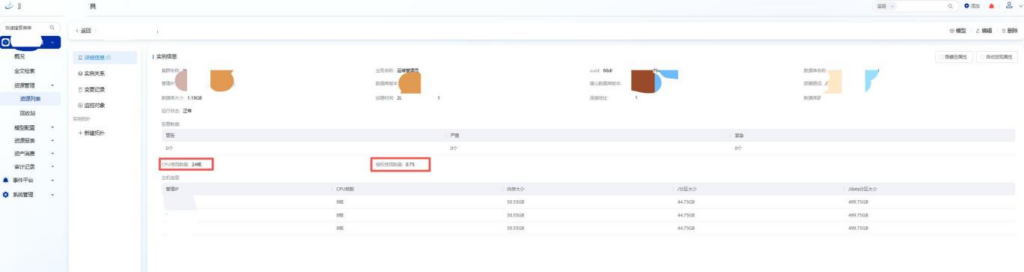
The unified management tool retrieves resource-related data from each database management platform through APIs, including but not limited to database instances, resource consumption, deployment information and other available resource metrics. It aggregates, counts and analyzes the data to provide administrators with a unified view of resource usage.
Real-time Monitoring
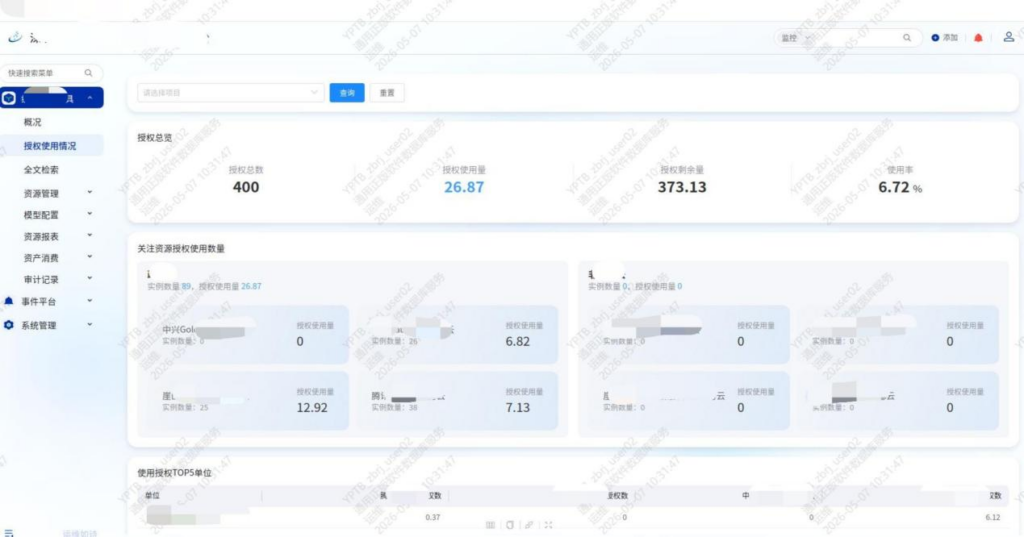
The unified management tool pulls license-related data provided by database platforms via APIs, and displays license usage for Tencent TDSQL, Huawei GaussDB, YashanDB and ZTE GoldenDB, including total licenses, used licenses and remaining licenses, with centralized aggregation and statistics. The tool collects data once every 24 hours. It calculates the license usage rate of each database platform based on total and remaining licenses. When remaining licenses drop below 30% of the total volume, the tool triggers alerts, supporting unified alert display and notification delivery.
User Permission Management
The unified management tool features user and role permission management. It supports centralized management of users and roles, with configurable system access and operation permissions for different users and roles to achieve fine-grained permission control.
Performance Analysis
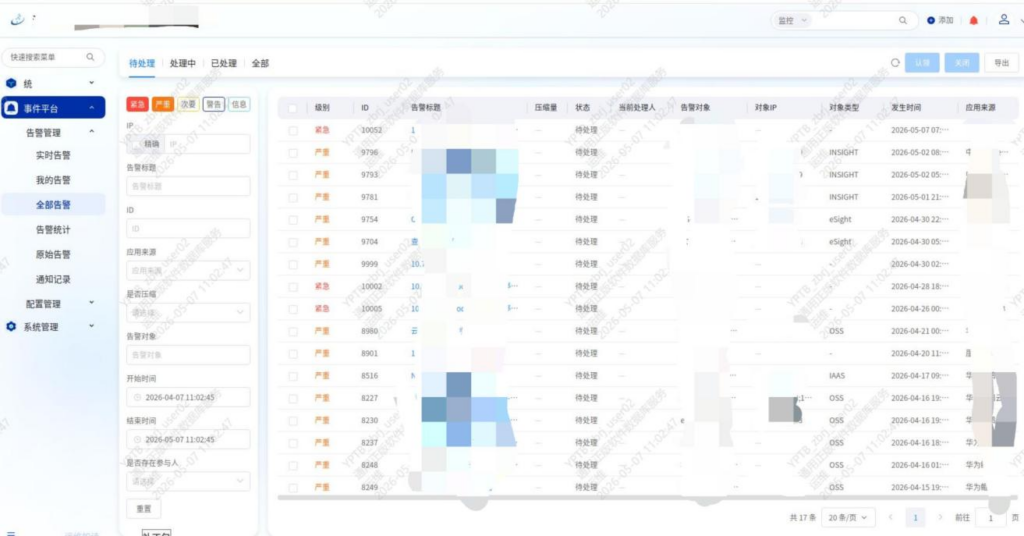
The unified management tool collects performance anomalies and alert data from the four database platforms via APIs, and centrally gathers, displays and manages all database performance alerts. It supports the assignment of performance alerts and pushes alert notifications to relevant O&M personnel through channels such as SMS gateways.
Security Auditing
The unified management tool provides security auditing functions. It records critical operations including user logins, data manipulations and permission changes to generate operation logs. Operation logs can be queried and filtered by user, operation type, operation time and other conditions, supporting operation tracing, security audits and fault location.
Backup Information Management
The unified management tool fetches database backup data from the four platforms via APIs for unified display and statistics. Each database platform provides fields for daily backup execution results. The unified tool captures backup task status, backup time, success/failure status and other information, enabling administrators to check all database backup status in one place.
API Integration
The unified management tool exposes standard APIs to connect with the municipal CDOS platform, comprehensive O&M management platform and other related systems. It can obtain data such as application tickets, user organization information and business system information, and return resource issuance status and other required data to associated platforms as needed, realizing unified data exchange for database software information.
Statistical Analysis
The unified management tool supports multi-dimensional statistical analysis of database product usage. Based on centrally collected data, it summarizes and analyzes database software consumption. Statistics and analysis can be grouped by user organization, business system, deployment environment, database product, time and other dimensions. Results are presented via statistical reports and charts to provide data support for resource usage analysis and management decisions.
Customer Value
By deploying the unified database software management tool, connecting to four database platforms and managing 400 licenses, scattered license, resource, alert and permission data are consolidated into a single entry, a unified set of rules and one integrated view. It delivers four core values: improved efficiency, cost reduction, enhanced security and data-driven decision-making.
Unified License Management: From cross-platform manual lookup to global monitoring on one screen License data from the four platforms is collected centrally. Total licenses, consumed volume and usage rate are displayed together, with query and analysis by project, user organization and other dimensions. Administrators no longer need to log into multiple platforms repeatedly. They can track citywide license status in real time, greatly improving license management efficiency and providing instant basis for resource allocation and future procurement.
Automated License Calculation: From manual aggregation to standardized automatic calculation The tool automatically obtains the CPU core count of hosts associated with each cluster, aggregates data by cluster, and calculates license consumption following unified rules to generate standardized statistical results. It drastically cuts manual workload, eliminates inconsistent statistical standards and human errors. License data is calculated accurately, quickly and verifiably, and statistics can be directly used for reconciliation and assessment.
Unified Alert Management: From isolated alerts to centralized aggregation and unified notification Alerts from the four platforms are fetched through APIs, displayed centrally and automatically sent to relevant staff via SMS and other channels. This shortens the chain of fault detection and response, mitigates business risks caused by missed alerts, and shifts operational assurance from passive patrol to active early warning.
Unified Resource View: From fragmented resources to clear inventory and data-backed decisions Database instance, resource consumption and deployment data are collected to form a unified resource view. Multi-dimensional statistics and analysis are available by user organization, business system, deployment environment, database product, time and more. The resource inventory is fully mapped. Underused and idle resources can be identified to facilitate resource reclamation and capacity planning. Management decisions shift from experience-based to data-driven, lifting overall resource utilization.
Unified Permission & Auditing: From scattered authorization to hierarchical control with full traceability A unified user, role and permission framework is established to enable differentiated access control. Key behaviors including login, data operation and permission modification are recorded persistently. This meets requirements for standardized management and security traceability, reduces risks of unauthorized operations, and ensures issues can be located and responsibilities traced.
- Case: HK Diversified Finance Firm’s Monitoring & Network Mgmt Platform
- Example of Upgrading the Operation and Maintenance Monitoring System in a Third Class Hospital
- Case Study: O&M Monitoring Platform for a Tertiary General Hospital in Shenzhen
- Case Study: Monitoring & Network Management for a Listed Electronic Circuit Substrate Enterprise
- Case Analysis: O&M Platform Implementation for a Global Cultural & Creative Tech Leader
- Case Study: IT O&M Platform for a Listed Special Materials High-Tech Firm
 Chinese (China)
 Chinese (Hong Kong)