


CMDB Unified Configuration Management Best Practices for Manufacturing: Production Line Downtime Is Counted by the Minute, But Asset Relationships Still Rely on Human Memory
From pre-shift inspections and workstation terminal startup to MES job dispatching, SCADA data collection and batch settlement, every critical action on the production line relies on the joint operation of industrial terminals, access networks, servers, databases and business systems. Unclear relationships in any link may turn a single alert into a production line shutdown lasting forty minutes or more.
The Lerwee CMDB solution integrates model configuration, compliance checking, resource management and monitoring linkage capabilities, covering three core scenarios: unified modeling, routine auditing and impact analysis. It helps manufacturing customers convert asset ledgers scattered across multiple departments and operation & maintenance vendors into queryable, verifiable and process-consumable configuration data.
In implemented projects, the team prioritizes model sorting over bulk data import. Nearly 20 types of IT and production line resources and more than a dozen historical spreadsheets are consolidated into a unified tree-style resource model. Manual quarterly inspection items are converted into automated rules for full daily comparison, with non-compliance lists automatically pushed to corresponding responsible persons.
All these capabilities serve one core goal: to clarify dependency relationships before failures occur, continuously verify data quality during daily operations, and quickly scope the impact after incidents arise. This empowers manufacturing maintenance teams to secure stable production with greater confidence.
Pain Points and Challenges for Discrete Manufacturing Groups
The value of CMDB in manufacturing first manifests in the ability to quickly answer “what is affected” once downtime happens. At 7:40 a.m., less than one hour after the morning shift starts at the final assembly workshop, MES workstation terminals on a production line go offline collectively. The on-duty engineer immediately checks the network, yet the critical questions to confirm are: which switch these terminals connect to, which cabinet the switch sits in, which plant the cabinet belongs to, which MES instance runs on it, and who the system owner and maintenance vendor are. By the time all relationships are confirmed and the root cause is verified as a failure of the access-layer switch, the production line has already been down for forty minutes.
This is not a problem of on-site response capability. Rather, asset relationships have never been managed as queryable, verifiable and consumable data. After multiple rounds of expansion and reorganization, the group operates across multiple sites, plants and legal entities. ERP, MES, SCADA, WMS, PLM intersect with financial and treasury systems. Servers, network and security devices, industrial terminals, computer room cabinets, software licenses and maintenance contracts are dispersed among different departments and vendors. Requirements to verify the full asset inventory and ownership accountability have reached an unprecedented level.
The first challenge lies in disjointed ledgers: one device may have three different identifiers. The IT department records IP addresses and hostnames; the equipment department tracks asset IDs and serial numbers; the finance department logs original values and depreciation; on-site plant Excel sheets separately record cabinet U-slots and maintenance expiration dates. After periodic stocktaking, names, responsible parties and statuses quickly become inaccurate again. Without a unified resource model, there is no shared language. Alert object names in monitoring cannot match asset ledgers, automation scripts cannot obtain trusted target lists, and ITSM work orders cannot be associated with configuration items.
A second challenge is that resource dependencies reside only in people’s minds, making failure impact scoping difficult. MES and SCADA depend on databases and middleware; databases run on virtualization clusters hosted on physical servers and storage, which are housed in specific cabinets and plants. These relationships are stored only in the experience of a small number of senior engineers. Missing links between hosts and virtual machines, applications and operating systems, and equipment and cabinets force engineers to make calls layer by layer for every alert. Impact analysis, change assessment, emergency drills and internal & external audits all lack reliable foundations.
Additionally, compliance relies on quarterly manual stocktaking with no continuous data validation mechanism. Cybersecurity 等级保护 assessments, group internal controls and external audits repeatedly require confirmation of: assigned owners for devices, upcoming maintenance contract expiry, expired software licenses, correct NTP/DNS settings for operating systems, long-unrebooted equipment, and hardware-cabinet associations. Previously handled via quarterly spot checks and spreadsheet updates, coverage is limited, and issues are often identified after the optimal remediation window closes. Most importantly, there was no set of rules to automatically and continuously flag non-compliant records.
For this reason, Lerwee CMDB starts from “one device, one relationship, one check item”. It connects the IT department, equipment department, plant teams and O&M vendors under one unified model, organizing modeling, validation, troubleshooting and changes around a single source of data.
Lerwee CMDB Unified Configuration Management Solution for Manufacturing
Built on an integrated monitoring foundation, Lerwee CMDB delivers end-to-end configuration management covering “modeling — validation — consumption” to directly address the three challenges outlined above.
01 Build a Unified Resource Model, So Each Device Has One Single Identifier
Lerwee CMDB manages resource models in a tree structure, supporting custom creation, import, export and cloning. Child models inherit attributes and relationships from parent models. CI attribute types include text, integer, float, IP/CIDR, date, enumeration, array, structure, boolean, image, file, phone number and calculated composite fields. Default values support static entries, serial numbers and auto-increment IDs, alongside cross-model references and custom mathematical formulas.
Model relationships can be defined with source-target relationship types such as belongs to, runs on, installed on, connects to, with custom AND/OR logical constraints. Visual model topologies and QR code labels are generated automatically. Derived metrics such as remaining cabinet U-slots and days until maintenance expiry are calculated automatically instead of being manually entered.
Before data is imported into the platform, a formal XX Group Resource Model Specification defines classifications, attributes, relationships, asset owners and data governance rules. The IT department, equipment department, finance team and O&M vendors can query from their respective business perspectives while reconciling against a shared standard.
02 Codify Inspection Items as Rules for Continuous Data Quality Validation
Compliance auditing supports custom asset inspection rules with conditions including equality, inclusion, uniqueness, empty-value checks, regular expressions, upcoming/expired dates, numeric range comparison, and cross-model validation along relationship paths.
Scenarios such as long-unrebooted devices, incorrect NTP/DNS configurations, expiring contracts, software version compliance, disk utilization, unassigned asset owners and unracked hardware can be scheduled for daily, weekly or monthly execution. Non-compliant records can be exported in one click and notified to responsible parties via email, SMS, enterprise instant messenger or custom scripts. Compliance statistics show top violation items and 30-day trend comparisons for side-by-side review of sequential audit runs.
Rules validate whether data already entered into CMDB complies with agreed standards. They do not replace physical on-site stocktaking or financial reconciliation, but create traceable records for remediation targets, supporting evidence and review outcomes.
03 Traverse Relationship Paths to Clarify Impact Scope for Every Alert
The resource management module centrally ingests network devices, security appliances, servers, storage, operating systems, databases, middleware, virtualization platforms, business applications and organizational entities. It supports fuzzy/exact multi-condition search, bulk import & export and custom column layouts. Attributes are grouped by model with empty values filtered automatically. Inspection timelines, pre/post change comparisons, archiving of critical attribute modifications and spare-parts inbound/outbound records form a full lifecycle trail for resources.
Instance topologies are auto-generated based on the defined model topology. Centered on a server, the location chain expands leftward: computer room — cabinet — server. The hosting chain expands rightward: operating system — middleware — application — business service. Business views display associated resources, owners, suppliers and system priority levels from the perspective of business applications. Computer room views visualize cabinet U-slot capacity and 3D large-screen location mapping, with automatic marking of U-slot conflicts.
When a storage alert triggers, the team can first identify the databases and virtualization clusters supported by that storage, then follow the dependency chain to view affected MES instances, workshops and maintenance contracts. Impacts can be grouped and compared by plant, business system or supplier to judge whether an isolated anomaly signals a systemic issue.
04 Two-Way Integration with Monitoring to Keep Ledgers Up-to-Date
CMDB and the monitoring platform work in bidirectional linkage. Monitoring metrics are automatically synchronized to update CMDB asset attributes according to predefined mapping rules, with native Zabbix connectivity requiring no secondary development. Create, edit and delete events for resources trigger real-time notifications and attribute-level subscriptions. Open integration via API, Kafka and RabbitMQ is also available for downstream consumption.
Combined with resource change approval, operation auditing, relationship path querying and custom reporting, configuration data can be reliably consumed by ITSM workflows and automation tools. Resources auto-discovered by monitoring are written back to CMDB in real time; CMDB relationships and attributes in turn power alert impact analysis. Configuration management therefore evolves from static spreadsheets into continuously consumable O&M metadata.
This fits customer environments with many business systems, where each service relies on multiple IT resources. Raw device metrics alone cannot reveal business impact, requiring a unified business-oriented monitoring perspective.
Three Scenarios: Putting Configuration Data into Daily O&M Work
After unified modeling and relationship association, data can be embedded into actual operational workflows. The following scenarios follow the lifecycle of modeling, routine validation and incident response.
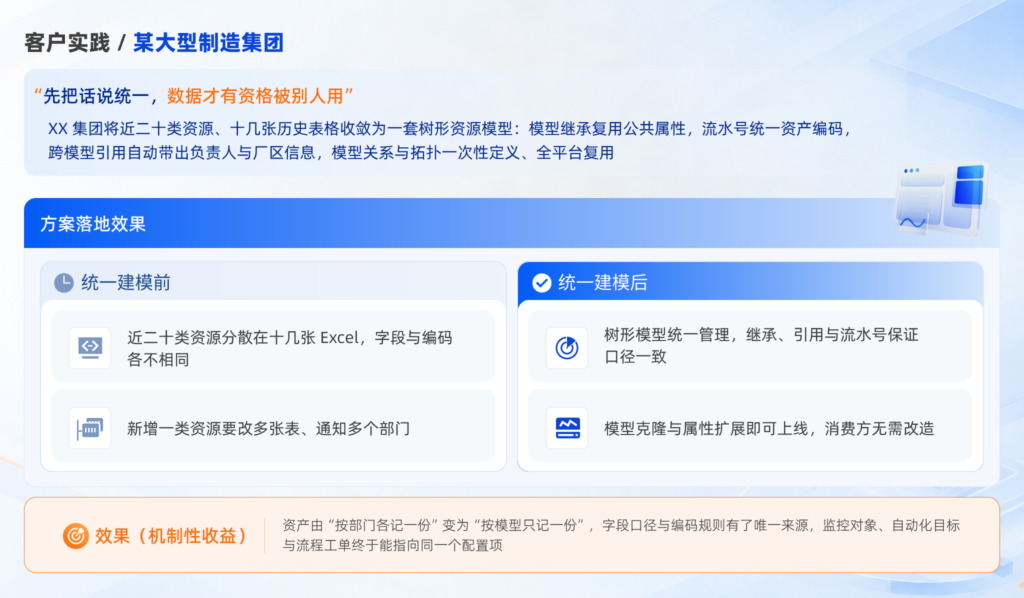
Scenario 1: Consolidate Dozens of Excel Sheets into One Unified Resource Model
Initial stocktaking at a large manufacturing group identified nearly 20 categories of IT and production-related resources: computer rooms, cabinets, UPS, precision air conditioners, physical servers, SAN storage, switches, firewalls, virtualization platforms, operating systems, databases, middleware, business applications, industrial terminals, software licenses, maintenance contracts, domain certificates and more. These were maintained separately across five internal departments and three outsourced O&M vendors using independent spreadsheets.
Field naming conventions, mandatory fields and coding standards were incompatible. One “operating system” model contained 8 fields in one sheet and 23 in another, with no single source of truth. Direct bulk import at this stage would only migrate the existing chaos into a new system.
Lerwee adopts model sorting ahead of data import, following a six-stage rollout framework: planning & preparation, model definition, platform deployment, data initialization, scenario enablement and iterative optimization, delivering a formal unified resource model specification.
Within Lerwee CMDB, model inheritance lets all operating system subtypes reuse parent-model attributes. Cross-model references automatically pull associated plant affiliation and application owner information. Serial numbers and auto-increment IDs generate standardized asset codes, while calculated attributes compute remaining cabinet U-slots and days until maintenance expiry. Model relationships and topologies are defined once and reused globally. Historical offline spreadsheets are deduplicated and validated before bulk import.
Scenario 2: Transform Quarterly Stocktaking into Daily Automated Audit Rules
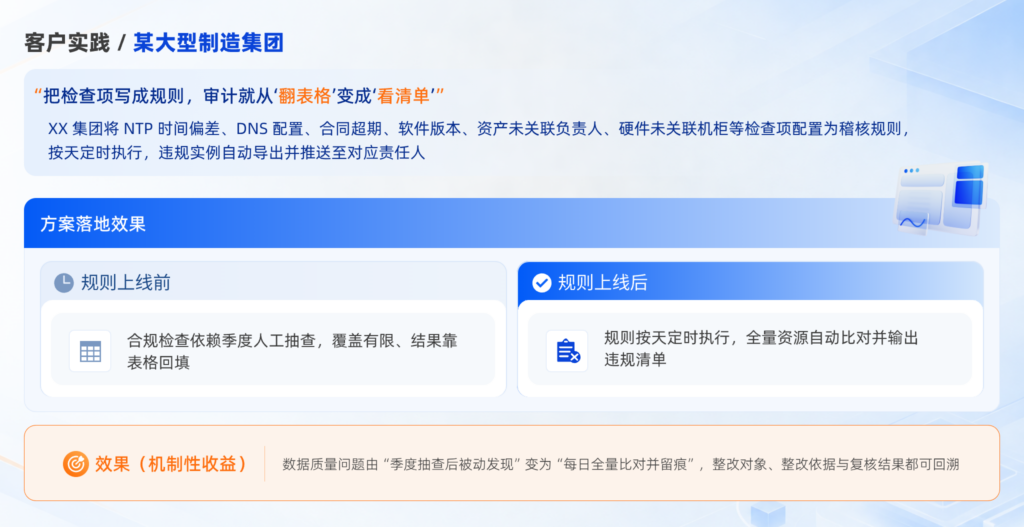
The group undergoes regular cybersecurity 等级保护 assessments, internal control reviews and external audits with highly repetitive checklists: confirmation of assigned asset owners, upcoming maintenance expiry, valid NTP/DNS configuration, system time drift under 1 second, regular device reboots, compliant software versions, hardware-cabinet association, and complete supplier & priority information for business systems. Previously handled via quarterly manual spot checks and spreadsheet updates, audits could not cover all assets, and the full loop of detection, assignment, remediation and review lacked traceable records.
Lerwee translates audit requirements directly into platform rules. Audit conditions (empty checks, uniqueness, regex, expiry alerts, numeric thresholds, etc.) are configured per model. Rules target assets without assigned owners, unracked network devices, expiring maintenance contracts, hosts with NTP offset over 1 second, and operating systems missing DNS configuration. Cross-model rules validate consistency across linked entities such as business applications, operating systems, suppliers and contracts.
Rules run on a daily schedule, with execution summaries, violation counts and historical records retained for review. Non-compliance details can be exported in one click and pushed to responsible parties via email, enterprise instant messenger or custom scripts. Compliance reporting ranks top violations and compares results across runs using 30-day trend charts.
Scenario 3: Move from Static Asset Ledgers to Business Impact Analysis
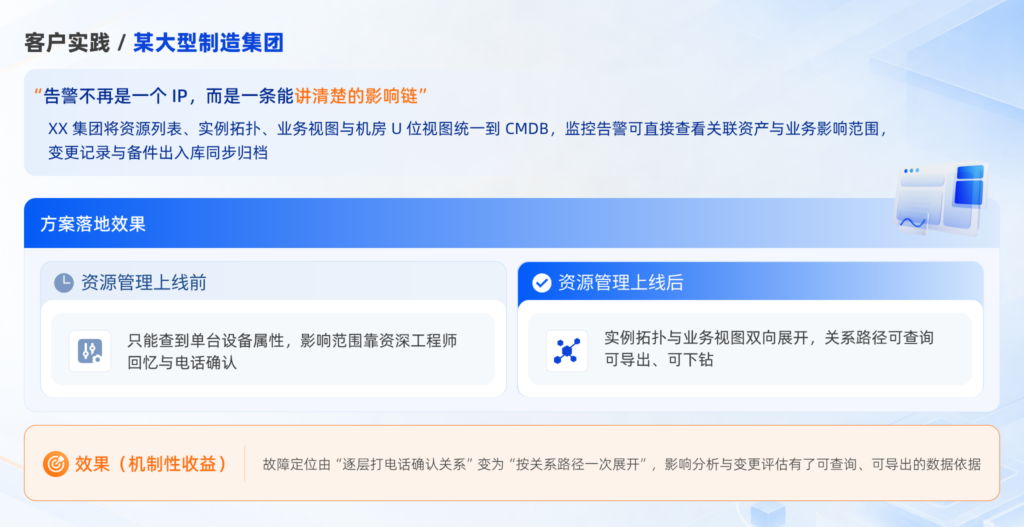
Even after ledgers are built, a common gap remains: assets can be queried but dependencies cannot be traced end-to-end. When a storage alert fires, on-call staff can locate the hardware in the resource list but cannot answer which MES instances it supports, which workshops are affected, or which suppliers and maintenance contracts apply. Cabinet U-slot data, spare-parts records and inspection logs remain siloed in separate systems. Changes are not version-compared, and modifications to critical attributes may go unnoticed for a long time.
Lerwee unifies the workflow of “resource — relationship — consumption” centered on resource management. The resource inventory centrally manages nearly 20 CI types. Auto-generated bidirectional instance topologies, business views and computer room 3D visualization deliver contextual positioning. Inspection logs, pre/post change diffs, critical change archiving and spare-parts records form a full lifecycle trail. Monitoring metrics sync back to CI attributes per mapping rules, and resource change events are subscribed by ITSM and automation platforms.
Investigations can start from a single device: trace its cabinet and plant, then follow the hosting chain to operating systems, databases, middleware and business applications, while cross-referencing concurrent change logs and maintenance contracts. With complete relationship mapping, teams can trace impact originating from an alert, group impacts by plant, business service or supplier, and determine whether isolated faults indicate broader systemic risks.
Customer Value: Embedding Configuration Data into Day-to-Day Operations
For discrete manufacturing groups, the value of configuration management must prove itself during every shutdown, every audit and every change. Based on the above scenarios and field delivery experience, Lerwee CMDB enables six core capabilities for maintenance teams.
Clearer Asset Inventory
Nearly 20 resource categories are maintained under one unified model with a single source of truth for naming, coding, ownership and status. New resource types can be onboarded quickly through model cloning and attribute extension, without circulating updated spreadsheets across departments.
Monitoring targets, automation endpoints and workflow work orders all reference the same configuration items. Stocktaking is no longer a separate manual project, but a reconciliation exercise against continuously maintained data.
Defined Failure Impact Scope
With instance topologies, business views and computer room visualizations, teams can expand a simple alert such as “storage device alarmed” into a full picture including location chain, hosting chain, affected services, suppliers and contracts, plus impacted plants and workshops.
On-duty engineers avoid repeated phone calls to piece together dependencies; development teams can trace faults along the relationship path, and production stakeholders can rapidly assess operational impact. The highest cost during downtime is not the repair work itself, but the dozens of minutes lost while reconstructing dependencies manually.
Streamlined Audit Readiness
Cybersecurity 等级保护,internal control and audit checklists run as daily automated rules. Violation lists are exported and routed to owners automatically, with sequential audit runs available for side-by-side comparison. Coverage expands from quarterly sampling to full daily validation.
Remediation targets, supporting evidence and review outcomes are fully traceable. Owners can identify recurring issues and schedule targeted governance. Audit preparation no longer means sorting through piles of spreadsheets; stakeholders open pre-generated compliance dashboards and violation reports.
Evidence-Based Change Assessment
Before a change, teams can traverse dependency paths to identify affected business services, underlying resources and accountable teams. After implementation, pre/post diffs and change audit logs verify that adjustments are properly recorded.
For resource configuration tweaks, new service rollouts or maintenance handovers, these relationships deliver queryable, exportable evidence for impact evaluation and reduce subjective judgement based solely on personal experience. The relationship graph answers critical questions: where to allocate upgrade budgets, and which stakeholders must be notified before a change.
Timely Data Updates
Monitoring metrics sync back to CI attributes per mapping rules. Auto-discovered resources are ingested into CMDB in real time. Create, update and delete events are pushed to ITSM and automation platforms via attribute-level subscriptions.
Ledgers no longer rely on quarterly stocktaking to stay accurate. Changes to configuration data are immediately available for consumption by workflows and automation. An outdated asset register is more dangerous than having no register at all, as it easily leads to incorrect operational decisions.
Smoother Cross-Department Collaboration
IT teams, equipment departments, on-site plant staff and O&M vendors work from the same model and dataset. The model specification formalizes classification, relationships and accountability, while audit rules route data-quality issues directly to the responsible owners.
A shared standard eliminates repeated spreadsheet exchanges and back-and-forth confirmation of naming conventions and timelines. Relationship paths, audit rules and model definitions validated during incident response can be reused for new plants and production lines, instead of rebuilding knowledge from scratch.
From aligning standards during modeling, to daily validation during steady-state operation, and rapid impact scoping after incidents, Lerwee CMDB connects devices, dependencies, owners and change records. It lets manufacturing O&M teams diagnose issues and coordinate responses using one consistent set of configuration data, while institutionalizing lessons for future plant rollouts.
Every device has a clear provenance. Every shutdown can have its impact quickly mapped. Teams gain greater confidence to sustain continuous production. This is the value of Lerwee CMDB’s unified configuration management practice for discrete manufacturing groups.
- How to replace SolarWinds to ensure enterprise IT security?
- Big News | Lerwee CMDB V7.0 Officially Released
- Private Sharing Session “Enabling AI to Truly Understand Enterprises” Suzhou Station Concludes Successfully
- Zabbix VS Lerwee Monitoring: Architecture & Performance
- Asset Discovery Best Practices: Eliminate Uncertainty Over Whether Devices Are Monitored
- CMDB Unified Configuration Management Best Practices for Manufacturing: Production Line Downtime Is Counted by the Minute, But Asset Relationships Still Rely on Human Memory
 English
 Chinese (China)