


SSL Certificate Automation: Total Game-Changer
Recently, League of Legends made the trending list due to an unexpected unscheduled maintenance shutdown. While the official team has not specified the exact cause, the industry widely speculates that it was triggered by the expiration of its 10-year SSL certificate issued back in 2016.
Many tech leads might think: “Just renew TLS/SSL certificates when they expire—what could possibly go wrong?” But against the backdrop of today’s complex IT architectures, this mindset is nothing short of playing with fire. With microservices, multi-cloud deployments and edge nodes in place, a mid-sized enterprise can easily have over a thousand certificates running concurrently. Rely on human memory to track them? Or manual processes to manage them? This is simply a counterintuitive design.

What’s more critical is the trend: the validity period of TLS/SSL certificates is being drastically shortened. It used to be 10 years, then 5 years; now it’s 13 months, and soon it will be 200 days, 100 days, and even 47 days.
This means that for the same level of management complexity, enterprises and organizations have to handle certificate renewals 10 to 20 times more frequently. Can your organization’s management capabilities keep pace with this speed? That’s a question that needs to be asked.

So how does Lerwee Monitoring address this?
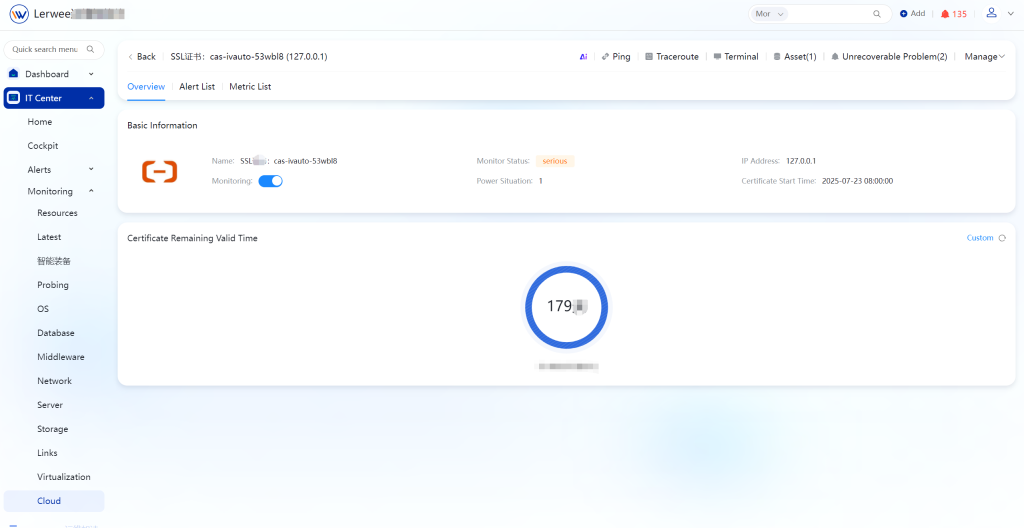
For SSL certificate management, Lerwee Monitoring offers a mature monitoring and automation solution that enables a complete closed loop from risk prediction to automatic resolution. SSL Certificate Monitoring: Achieve SSL certificate monitoring via automatic discovery or manual addition, with support for viewing various metrics such as the remaining valid time and certificate type of each certificate.
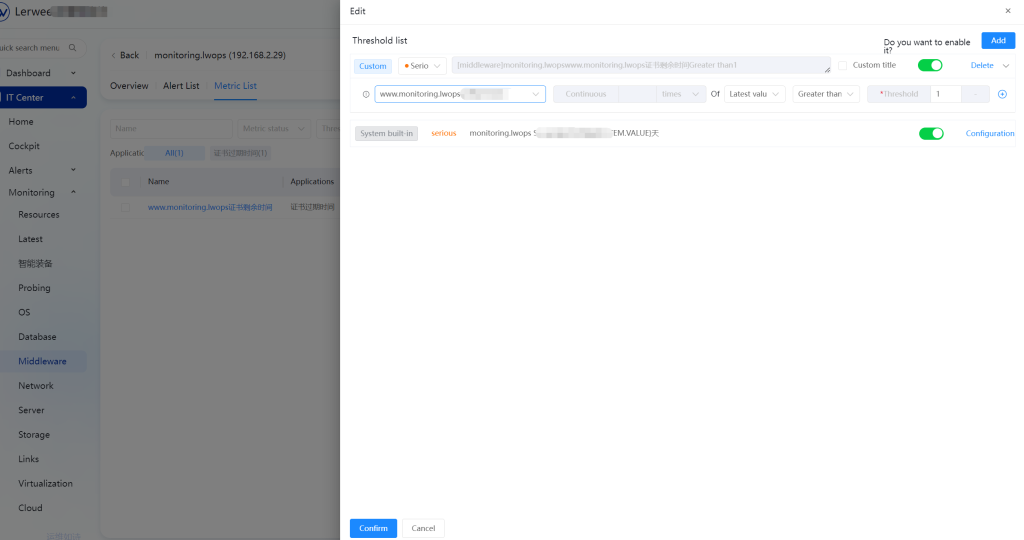
Alert Threshold Setting: When the remaining valid time of an SSL certificate falls below the preset threshold, the system automatically pushes alert notifications. For example, an alert of “Alert” level will be triggered if the remaining valid time of an SSL certificate is less than six months.
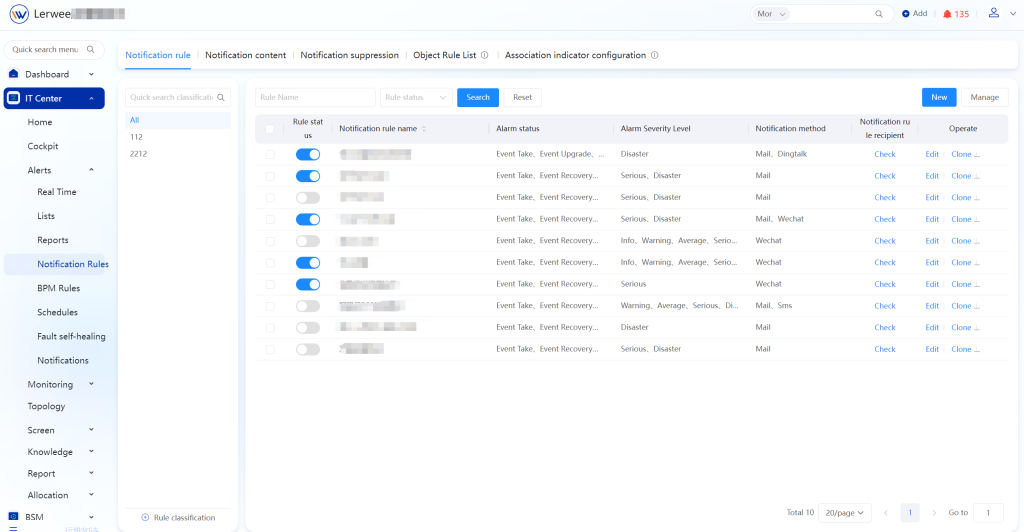
Alert Notification Delivery Rules Configuration: Choose from multiple delivery methods including email, SMS, WeChat Work, DingTalk, and custom scripts. Notifications will be automatically pushed when the alert conditions are met.
One-Click Detection & Script Execution for Renewal: After receiving an alert about an expiring SSL certificate, administrators can log in to the platform, locate the alert and perform a one-click detection. The SSL certificate renewal process is then completed by executing the dedicated SSL certificate restoration script.
In addition, the platform also supports SSL certificate renewal via script self-healing, scheduled tasks and other built-in features.
- Network visualization detection enables rapid troubleshooting
- Essential O&M Tools! OS Monitoring Explained
- Comparative Analysis of Zabbix and Lerwee Monitoring (Part 3) - Object Management
- Lerwee NMS vs. Solarwinds NPM Network Performance Monitoring (Part 3)
- Release of Lerwee Network Management Platform 8.0
- Lerwee Encyclopedia: What’s IT Monitoring? Why Monitor in O&M?
 Chinese (China)
  Chinese (Hong Kong)